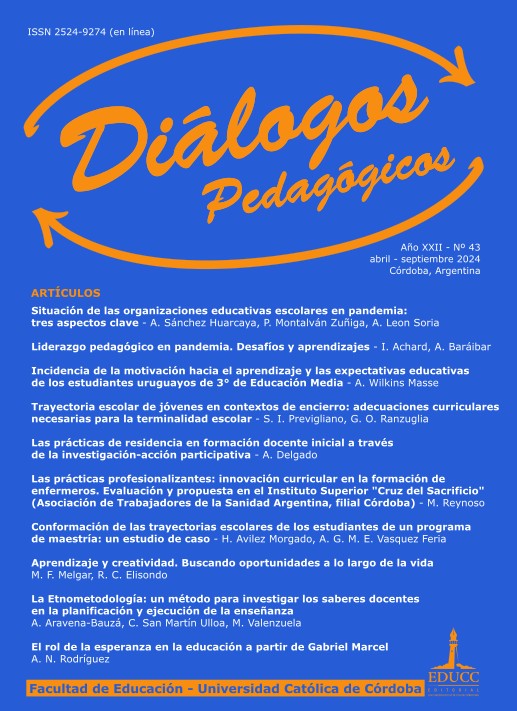
Las prácticas de residencia en formación docente inicial a través de la investigación-acción participativa
Residency practices in initial teacher training through research-participatory action
DOI:
https://doi.org/10.22529/dp.2024.22(43)05Palabras clave:
residencia de estudiantes, modelo didáctico, relación profesor-alumno, innovación, investigación-acciónResumen
Este artículo aborda una investigación basada en la metodología de investigación acción participativa. Se ha desarrollado en la ciudad de Cruz del Eje, cuyos participantes fueron profesores de Práctica Docente IV y residentes de los profesorados de educación inicial y primaria, directivos y docentes de tres escuelas asociadas. El objetivo general es analizar y reflexionar la forma que adquiere el acompañamiento en la residencia y lo enriquecedora que puede resultar la experiencia coparticipativa a partir de metodologías que permitan contribuir a un encuentro entre formación e investigación. Entre los resultados encontrados, se identificó la incidencia de la biografía escolar en la residencia. La construcción de dispositivos y espacios para la mejora de una cultura colaborativa se vio favorecida por la participación voluntaria e interesada de los participantes en distintas experiencias, aunque permanecen aspectos a mejorar respecto del vínculo entre residente y docente orientador.Descargas
Referencias
Álvarez, Z., Porta, L. y Sarasa, M. C. (2010). La investigación narrativa en la enseñanza y la biografía de los profesores memorables. Revista de Educación 1, 159-179.
Alliaud, A. (1999). Las autobiografías escolares como métodos e instrumentos de indagación y transformación de la docencia. Revista Ensayo y Error, VIII(16/17), 51-52.
Anderson, G., Herr, K. y Nihlen, A. S. (2007). Studying your own school: An educator's guide to qualitative practitioner research. Corwin Press.
Bisquera, R. (2009). Metodología de la investigación educativa. Editorial La Muralla.
Bromberg, A. M., Kirsanov, E. y Longueira Puente, M. (2008). Formación profesional docente. Paidós.
Bourdieu, P. (1990). El sentido práctico. Taurus.
Carr, W. y Kemmis, S. (1986). Becoming critical: Education, knowledge and action research. Routledge Falmer Press. https://doi.org/10.4324/9780203496626.
Carr, W. y Kemmis, S. (1988). Teoría crítica de la enseñanza. La investigación acción en la formación del profesorado. Martínez Roca.
Colmenares, A. M. y Piñero, M. L. (2008). La investigación acción. Una herramienta metodológica heurística para la comprensión y transformación de realidades y prácticas socioeducativas. Laurus. Revista de Educación, 14(27), 96-114. https://www.redalyc.org/articulo.oa?id=76111892006
Cochran-Smith, M. y Lytle, S. L. (1999). Relationships of Knowledge and Practice: Teacher Learning in Communities. Review of Research in Education, 24, 249-305. https://www.jstor.org/stable/1167272
Cochran-Smith, M., Barnatt, J., Friedman, A. y Pine, G. (2009). Inquiry on inquiry: Practitioner research and student learning. Action in Teacher Education, 31(2), 17-32.https://doi.org/10.1080/01626620.2009.10463515
Córdoba, Argentina. Dirección General de Educación Superior. (2015). Diseño Curricular Jurisdiccional. https://ensurquiza-cba.infd.edu.ar/sitio/upload/Disenio_Curr_Primaria_Inicial_2015.pdf
Darling-Hammond, L. (2006). Constructing 21st-century teacher education. Journal of Teacher Education, United States, 57, 300-314. file:///C:/Users/54354/Desktop/Constructing21stCenturyTchrEd.pdf
Delgado, A. M. (2022). El docente orientador en la formación docente inicial. Un estudio cualitativo de las concepciones y los recorridos pedagógicos que definen el acompañamiento en la residencia. Diálogos Pedagógicos, 20(40), 48-67. https://doi.org/10.22529/dp.2022.20(40)04
Devalle de Rendo, A. (2009). La formación docente. Según las representaciones de los futuros maestros. Lugar Editorial.
Devalle de Rendo, A. y Vega, V. (2006). Una escuela en y para la diversidad. El entramado de la diversidad. Grupo Editor Aique.
Ferry, G. (1997). Pedagogía de la Formación. Ediciones Novedades Educativas. Universidad de Buenos Aires.
Kemmis, S. y McTaggart, R. (1988). Cómo planificar la investigación-acción. Laertes.
Larrosa, J. (1995). Tecnologías del yo y educación (Notas sobre la construcción y la mediación pedagógica de la experiencia de sí). En J. Larrosa, Escuela, poder y subjetivación (pp. 257-361). La Piqueta.
Lewin, K. (1948). Resolving Social Conflicts, Selected Papers on Group Dynamics (1935-1946). Harper.
Marrero, J. (1993). Las teorías implícitas del profesorado: Vínculo entre la cultura y la práctica de la enseñanza. En M. J. Rodrigo, A. Rodríguez y J. Marrero (Eds.), Las teorías implícitas. Una aproximación al conocimiento cotidiano (pp. 243-276). Visor.
Martínez, M. (1999). La investigación cualitativa etnográfica en educación. Trillas.
McMillan, J. H. y Schumacher, S. (2005). Investigación educativa. Pearson.
Melero, N. (2012). El paradigma crítico y los aportes de la investigación acción participativa en la transformación de la realidad social: un análisis desde las ciencias sociales. Cuestiones Pedagógicas, 21, 339-355. https://idus.us.es/bitstream/handle/11441/12861/file_1.pdf?sequence=1&isAllowed=y
Phillips, D. K. y Carr, K. (2009). Dilemmas of trustworthiness in preservice teacher action research. Action Research, 7(2), 239-258. https://doi.org/10.1177/1476750308097027
Pérez Gómez, A. I. (1985). La comunicación didáctica. Universidad de Málaga, Secretariado de Publicaciones.
Pérez-Van-Leenden, M. de J. (2019). La investigación acción en la práctica docente. Un análisis bibliométrico (2013-2017). Magis. Revista Internacional de Investigación en Educación, 12(24), 177-192. https://www.studocu.com/es-mx/document/universidad-nacional-autonoma-de-mexico/psicologia/la-investigacion-accion-en-la-practica-docente-un-analisis/27126862
Perrenoud, P. (2001). La formación de los docentes en el siglo XXI. Revista de Tecnología Educativa, XIV(3), 503-523. https://programa4x4-cchsur.com/wp-content/uploads/2016/11/La-formacion-de-los-docentes-en-el-siglo-XXI_Perrenoud.pdf
Rodríguez-Gabarrón, L. y Hernández Landa, L. (1994). Investigación participativa. Colección Cuadernos Metodológicos, Nro. 10. Centro de Investigaciones Sociológicas.
Sales Ciges, A., Moliner García, O. y Traver Martí, J. A. (2019). Redefiniendo el territorio de la escuela: espacios educativos para la transformación social. Revista Fuentes, 21(2), 177-188. https://revistascientificas.us.es/index.php/fuentes/article/view/10741/9717
Sanjurjo, L. (2009). (Coord.). Los dispositivos para formación en las prácticas profesionales. Homosapiens.
Schön, D. (1987). La formación de profesionales reflexivos. Paidós.
Somekh, B. y Zeichner, K. (2009). Action research for educational reform: Remodeling action research theories and practices in local contexts. Educational Action Research, 17(1), 5-21. https://www.tandfonline.com/doi/full/10.1080/09650790802667402
Zeichner, K. y Noffke, S. (2001). Practitioner research. En V. Richardson (Ed.), Handbook of research on teaching (pp. 298-330). AERA.
Publicado
Número
Sección
Licencia
Derechos de autor 2024 Alejandra Delgado

Esta obra está bajo una licencia internacional Creative Commons Atribución-NoComercial-SinDerivadas 4.0.
Cómo citar