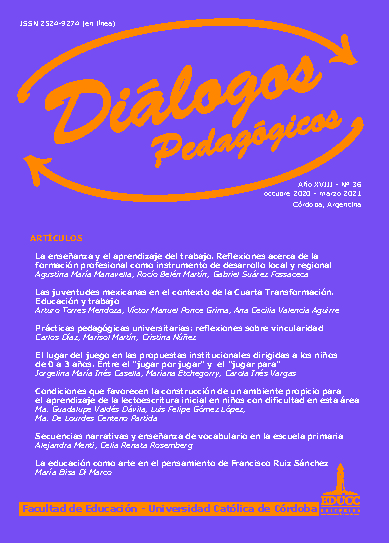
La enseñanza y el aprendizaje del trabajo. Reflexiones acerca de la formación profesional como instrumento de desarrollo local y regional
DOI:
https://doi.org/10.22529/dp.2020.18(36)01Abstract
The article aims to delve into the understanding of the learning-workrelationship within the structure of a panel, which is understood as a proposal ofprofessional training carried out in a context of non-formal learning. The paper recognizesthe contributions of various theories that allow conceptualizing training for work.The work in a professional training panel, as an instrument of local and regionaldevelopment, was analyzed. This activity was carried out during the teaching ofundergraduate-level classes, offered by a university in the province of Córdoba.The obtained results allow us to recognize that the analyzed panel constitutes a valuablecontribution when thinking about the proposals for professional training, since itpromotes instances of interaction and it constitutes a space for social co-constructionof knowledge, offering training linked to specific pedagogical and didactic aspects ofwork education. Keywords: informal education, non-formal education, professional training, bachelor'sdegree.Downloads
References
Bell, S. (2009). Mujeres en la ciencia: maximización de la productividad, la diver-sidad y la innovación. Canberra: Federación de Sociedades Científicas y Tecnoló-gicas de Australia (FASTS).
Chaiklin, S. y Lave, J. (2001). Estudiar las prácticas. Perspectivas sobre actividady contexto. Buenos Aires: Amorrortu.
Collins, A. & Kapur, M. (2014). Cognitive apprenticeship. En R. K. Sawyer (Ed.),The Cambridge Handbook of the Learning Sciences (pp. 109-127). Cambridge, UK:Cambridge University Press. https://doi.org/10.1017/CBO9781139519526.008
Collins, A., Brown, J. S. & Newman, S. E. (1989). Cognitive apprenticeship: Teachingthe crafts of reading, writing, and mathematics. En L. B. Resnick (Ed.), Knowing,learning, and instruction: Essays in honor of Robert Glaser (pp. 453-494). https://doi.org/10.4324/9781315044408-14
Hillsdale,NJ, US: Lawrence Erlbaum Associates, Inc.Denzin, N. K. & Lincoln, Y. S. (1994). Introduction: Entering the Field of QualitativeResearch. En N. K. Denzin & Y. S. Lincoln (Eds.), Handbook of Qualitative Research(pp. 1-17). California: Sage.
Dieleman, H. & Juárez-Nájera, M. (2008). ¿Cómo se puede diseñar educación parala sustentabilidad? Revista Internacional de Contaminación Ambiental, 24(3), 131-147. Disponible en: http://www.scielo.org.mx/scielo.php?script=sci_arttext&pid=S0188-49992008000300004&lng=es&nrm=iso.
Ermida Uriarte, O. (2001). Trabajo decente y formación profesional. Montevideo:CINTERFOR.
Fermoso, P. (1997). Interculturalismo y educación no formal. En A. Petrus (Ed.),Pedagogía Social (pp. 248-267). Barcelona: Ariel.
Flick, U. (2004). Introducción a la investigación cualitativa. Madrid: Morata.
Heras I Trias, P. (1997). Pedagogía ambiental y educación social. En A. Petrus(Ed.), Pedagogía Social (pp. 268-287). Barcelona: Ariel Educación.
Julien, J. (1997). Explaining learning: the research trajectory of situated cognitionand the implications of connectionism. En D. Kirshner & J. Whitson, Situated Cognition:social, semiotic and psychological perspectives (pp. 261-279). New Jersey: Lawrence https://doi.org/10.4324/9781003064121-10
Erlbaum Associates.Lave, J. & Wenger, E. (1991). Situated Learning: Legitimate Peripheral Participation.Cambridge, UK: Cambridge University Press. https://doi.org/10.1017/CBO9780511815355
Manavella, A. M., Martín, R. B. & Donolo, D. S. (2020). Zapatero a tus zapatos.Aprendizaje de oficios. Edetania. Estudios y Propuestas Socioeducativas, 57, 63-84. Disponible en: https://doi.org/10.46583/edetania_2020.57.443
Martín, R. B. (2014). Contextos de aprendizaje. Formales, no formales e informa-les. IKASTORRATZA e-Revista de Didáctica, 12. Disponible en: http://www.ehu.eus/ikastorratza/12_alea/contextos.pdf.
Martín, R. B. (2016). Los procesos de participación periférica legítima en dos con-textos diversos. Revista Fronteiras, 5(3). Disponible en: https://doi.org/10.21664/2238-8869.2016v5i3.p205-218
Petrus, A. (coord.) (1997). Pedagogía Social. Barcelona: Ariel Educación.
Trilla, J., Gros, B., López, F. & Martín, M. J. (2003). La educación fuera de la escue-la: ámbitos no formales y educación social. Barcelona: Ariel Edición.
Downloads
Published
Issue
Section
License
Copyright (c) 2020 Diálogos Pedagógicos

This work is licensed under a Creative Commons Attribution-NonCommercial-NoDerivatives 4.0 International License.
How to Cite