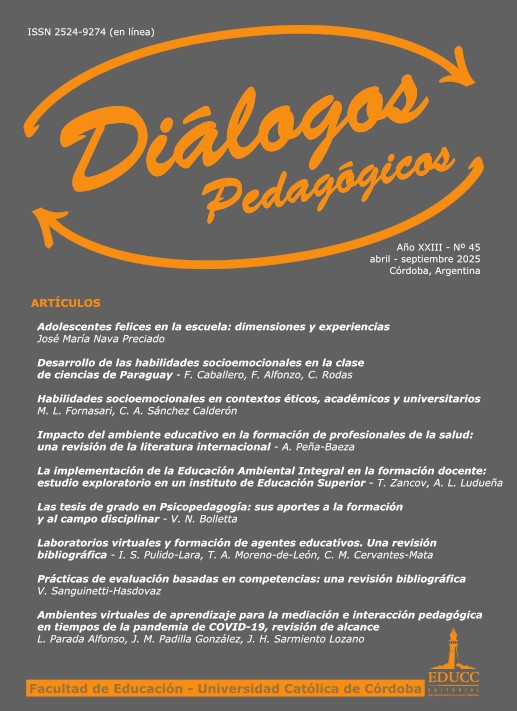
Impacto del ambiente educativo en la formación de profesionales de la salud: una revisión de la literatura internacional
DOI:
https://doi.org/10.22529/dp.2025.23(45)04Palabras clave:
condiciones de aprendizaje, vida estudiantil, personal sanitario, Educación Superior, actitud del estudianteResumen
El ambiente educativo influye en cómo los estudiantes habitan los espacios de formación. Este ambiente se dimensiona en infraestructura, métodos de enseñanza y las relaciones en la comunidad educativa. En Educación Superior, específicamente, en formación en salud, destaca la influencia de las relaciones interpersonales entre pares y docentes, la calidad de la infraestructura, los materiales y la enseñanza. En esta revisión, aplicando la estrategia PRISMA, se seleccionan siete de setenta artículos y se destacan hallazgos relacionados a los espacios educativos, los vínculos, la enseñanza práctica. Además, se subraya la necesidad de gestar comunidades de aprendizaje inclusivas para el bienestar emocional y el rendimiento académico de los estudiantes. Se concluye que mejorar el ambiente educativo en salud requiere estrategias basadas en evidencia que aborden las diferencias culturales y las necesidades específicas de los estudiantes, que integren aspectos de dimensión espiritual y de diversidad cultural en el currículo no formal.Descargas
Referencias
Abusaad, F., Mohamed, H. y El-Gilany, A. (2015). Nursing students' perceptions of the educational learning environment in pediatric and maternity courses using DREEMquestionnaire. Journal of Education and Practice, 6(29), 26-32. https://qrcd.org/8Lml
Braun, V. y Clarke, V. (2006). Using thematic analysis in psychology. QualitativeResearch in Psychology, 3(2), 77-101.
https://doi.org/10.1191/1478088706qp063oa
Corcoran, L., Exner-Cortens, D. y Wells, L. (2019). Advancing healthy and sociallyjust schools and communities: An interdisciplinary graduate program. InternationalJournal of Teaching and Learning in Higher Education, 31(2), 287-298. https://qrcd.org/8Lms
do Vale Placa, R., Ragghianti Zangrando, M. S., Sant'Ana, A. C. P., Greghi, S. L. A.,de Rezende, M. L. y Damante, C. A. (2015). Evaluation of a Brazilian postgraduate dental program by the Dundee Ready Educational Environment Measure.International Education Studies, 8(11), 34-39. https://doi.org/10.5539/ies.v8n11p34
Duarte, J. (2003). Ambientes de aprendizaje: una aproximación conceptual. Estu-dios Pedagógicos (Valdivia), 29, 97-113. https://doi.org/10.4067/S0718-07052003000100007
Espiritu, E., TenHaken-Riedel, J., Brown, R., Frame, R., Adam, J., Koch, A.,Lemmonds, T., Dawson, A., Herrera, A., Markley Jones, K., Myers, C. y Owens, A.(2020). Incorporating spirituality into graduate health professions education.Christian Higher Education, 19(4), 254-271. https://doi.org/10.1080/15363759.2019.1687050
Gurayah, T. (2022). An exploration of the facilitating factors in completing anundergraduate occupational therapy degree at the University of KwaZulu-Natal,South Africa. Africa Education Review, 19(3), 1-18. https://doi.org/10.1080/18146627.2023.2278050
Hardiman, M. (2012). Brain Target Teaching. SAGE.Hashmi, A., Bennett, A., Tajuddin, N., Hester, R. y Glenn, J. (2021). Qualitativeexploration of the medical learner's journey into correctional health care at anacademic medical center and its implications for medical education. Advances inHealth Sciences Education, 26(2), 489-511. https://doi.org/10.1007/s10459-020-09997-4
Hernández-Sampieri, R. M. (2018). Metodología de la investigación. Las rutas cuan-titativa, cualitativa y mixta. McGraw-Hill.
Montero, J. (2009). En acción, filosofía de la mente y el yo. Franciscanum. Revista de las ciencias del espíritu, LI(152), 133-179. https://www.redalyc.org/articulo.oa?id=343529072005
Mousavi, A. E., Mohammadia, A., Mojtahedzadeha, R., Shirazib, M. y Rashidi, H.(2020). E-Learning Educational Atmosphere Measure (EEAM): A new instrument for assessing e-students' perception of educational environment. Research inLearning Technology, 28. https://doi.org/10.25304/rlt.v28.2308
Oderinu, O. H., Balogun, M. y Pugsley, H. (2024). Exploring dental students'perceptions of their clinical learning environment: A qualitative study to evaluate the curriculum. International Journal of Research in Education and Science (IJRES),10(2), 279-298. https://doi.org/10.46328/ijres.3364
Ojeda, C. (2001). Francisco Varela y las ciencias cognitivas. Revista chilena deneuro-psiquiatría, 286-295.
https://doi.org/10.4067/S0717-92272001000400004
Organisation for Economic Co-operation and Development [OCDE] (2018). Educa-ción en Chile. Evaluaciones de Políticas Nacionales de Educación. OCDE/FundaciónSM. https://doi.org/10.1787/9789264288720-es
Organización Mundial de la Salud (2016). Estrategia mundial de recursos humanos para la salud: personal sanitario 2030. 69a Asamblea Mundial de la Salud. https://iris.who.int/handle/10665/254600
Penman, J., Malik, G., Chu, M. E., Kett, G., Hampton, K., Thomacos, N., Ebrahimi-Zanjani, M., Zhong, Y., McKenzie, W. (2021). Empowering international students tosucceed: An innovative and beneficial initiative for health professions. Journal ofInternational Students, 11(4), 832-852. https://doi.org/10.32674/jis.v11i4.2226
Peña, A. (2022). Exploración de las percepciones de los estudiantes sobre el am-biente educativo en una Facultad de Salud [Tesis de Magister en Administración yDirección de Empresas. Facultad de Administración y Economía. Universidad de Santiago de Chile]. https://qrcd.org/8PqY
Peña, A. (2023). Ambiente educativo: una revisión en revistas chilenas. Palimpsesto,13(23),120-134 https://qrcd.org/8PqJ
Peña Baeza, A. (2024). Definiciones de experiencia desde la revisión de las co-rrientes de la fenomenología y el pragmatismo. MAD, (50), 63-77. https://doi.org/10.5354/0719-0527.2024.75577
Roff, S. (2005). The Dundee Ready Educational Environment Measure (DREEM)-ageneric instrument for measuring students' perceptions of undergraduate healthprofessions curricula. Medical Teacher, 27(4), 322-325. https://doi.org/10.1080/01421590500151054
Rusticus, S., Wilson, D., Jarus, T., O'Flynn-Magee, K. y Albon, S. (2022). Exploringstudent perceptions of the learning environment in four health professions educationprograms. Learning Environments Research, 25(1), 59-73. https://doi.org/10.1007/s10984-021-09349-y
Sulelino, R., Chen, Y. y Henning, M. (2021). Exploring Papuan medical students'learning experiences whilst studying in Indonesia. The Australian Journal ofIndigenous Education, 50(2), 368-376. https://doi.org/10.1017/jie.2020.7
van Manen, M. (2003). Investigación educativa y experiencia vivida. Idea Books.
Varela, F. (1991). Ética y acción. Dolmen Ensayos.
Varela, F. (2000). El fenómeno de la vida. Dolmen.
Publicado
Número
Sección
Licencia
Derechos de autor 2025 Alonso Peña-Baeza

Esta obra está bajo una licencia internacional Creative Commons Atribución-NoComercial-SinDerivadas 4.0.
Cómo citar