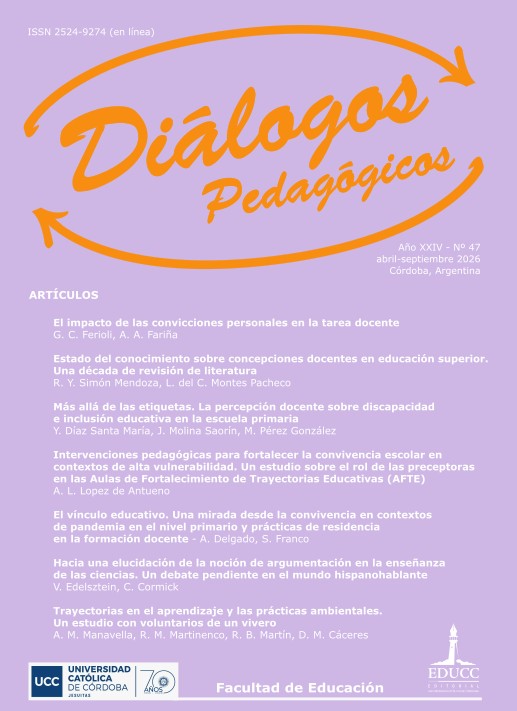
El impacto de las convicciones personales en la tarea docente
DOI:
https://doi.org/10.22529/dp.2026.24(47)01Palabras clave:
ética del docente, educación inclusiva, discapacidad sensorial, relación escuela-comunidad, práctica pedagógicaResumen
El presente artículo de reflexión académica analiza la incidencia de las convicciones y creencias personales en el ejercicio de la docencia, entendiéndolas como núcleos de sentido que configuran la identidad profesional y orientan la praxis. El objetivo principal es examinar cómo estas estructuras subjetivas condicionan la toma de decisiones y la búsqueda de soluciones educativas situadas, especialmente en contextos de discapacidad. Metodológicamente, el trabajo se sustenta en un enfoque cualitativo-narrativo a través de un estudio de caso único: la trayectoria escolar de una estudiante con sordoceguera en Córdoba, Argentina. Los resultados sugieren que la transición de una racionalidad técnica hacia una práctica reflexiva permite trascender las limitaciones normativas. Se concluye con la recomendación de incorporar espacios de reflexión sobre la propia práctica, entendida como un proceso donde la subjetividad y las convicciones personales guían la toma de decisiones pedagógicas para garantizar una educación orientada a la justicia social.Descargas
Referencias
Ball, S. J. (2003). The teacher's soul and the terrors of performativity. Journal of Education Policy, 18(2), 215-228. https://doi.org/10.1080/0268093022000043065
Dewey, J. (1989). Cómo pensamos: Nueva exposición de la relación entre pensamiento reflexivo y proceso educativo. Paidós.
Fullan, M. (2001). The new meaning of educational change (3.ª ed.). Routledge.
Larrosa, J. (2006). Sobre la experiencia. Aloma: Revista de Psicologia, Ciències de l'Educació i de l'Esport, (19), 87-112. https://raco.cat/index.php/Aloma/article/view/103367
Ortega y Gasset, J. (1983). Ideas y creencias. Alianza.
Pajares, M. F. (1992). Teachers' beliefs and educational research: Cleaning up a messy construct. Review of Educational Research, 62(3), 307-332. https://doi.org/10.3102/00346543062003307
Perrenoud, P. (2004). Diez nuevas competencias para enseñar (4.ª ed.). Graó.
Schön, D. A. (1992). La formación de profesionales reflexivos: Hacia un nuevo diseño de la enseñanza y el aprendizaje en las profesiones. Paidós.
Skliar, C. (2017). Pedagogías de las diferencias. Noveduc.
Yin, R. K. (2009). Case study research: Design and methods (4th ed.). Sage.
Publicado
Número
Sección
Licencia
Derechos de autor 2026 Graciela Celestina Ferioli, Andrea Alejandra Fariña

Esta obra está bajo una licencia internacional Creative Commons Atribución-NoComercial-SinDerivadas 4.0.
Cómo citar