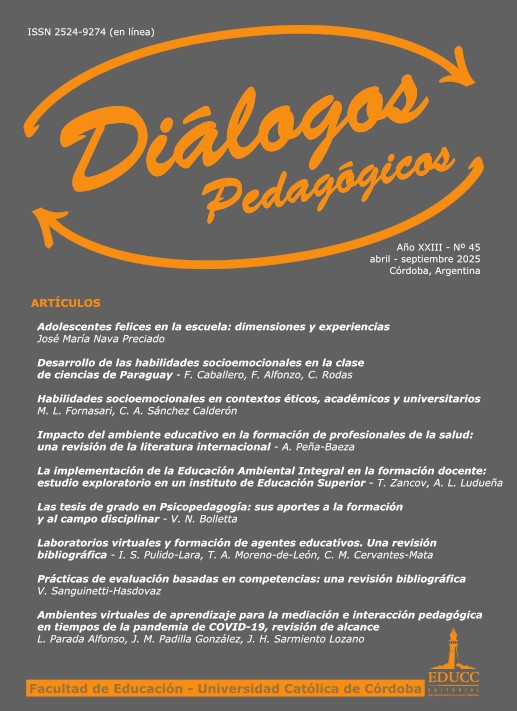
Las tesis de grado en Psicopedagogía: sus aportes a la formación y al campo disciplinar
DOI:
https://doi.org/10.22529/dp.2025.23(45)06Palabras clave:
formación profesional, aprendizaje, PsicopedagogíaResumen
Este artículo se propone compartir un análisis del aporte de la investigación a la formación y al campo disciplinar de la Psicopedagogía a partir de la sistematización y el análisis de las tesis de grado de los estudiantes de la carrera Licenciatura en Psicopedagogía de la Universidad Nacional del Comahue, Complejo Universitario Regional Zona Atlántica y Sur (CURZAS). Considero que las producciones de las tesis de grado sostienen una forma de comprender y pensar la Psicopedagogía, que es pasible de lectura y que permite un acercamiento conceptual a la producción de saberes en la disciplina en este camino de consolidación científica. En el desarrollo del artículo, se analizan las áreas problemáticas, la construcción de objeto y las definiciones teóricas y metodológicas de las tesis por ámbito de inserción laboral de los psicopedagogos y, luego, se desarrolla una reflexión epistemológica sobre los aportes de la formación en investigación al campo disciplinar.Descargas
Referencias
Arnoux, E., Borsinger, A., Carlino, P., Di Stefano, M., Pereira C. y Silvestri, A.(2004). La intervención pedagógica en el proceso de escritura de tesis de posgrado.Revista de la Maestría en Salud Pública, 2(3), 1-16.
Bertoldi, S. y Porto, M. (2018). Investigación en psicopedagogía: aplicación de unaherramienta de lectura epistemológica. Revista Pilquén. Sección Psicopedagogía,1(15), 33-41. http://revele.uncoma.edu.ar/index.php/psico/article/view/1915
Bolletta, V. y Castillo, A. (2021). La investigación como proceso de transmisión yaprendizaje: reflexiones de la práctica docente. En S. Bertoldi (Comp.), Epistemo-logía y Psicopedagogía. Revisitando nuestras prácticas docentes universitarias (pp.161-174). La Hendija.
Bolletta, V., Castillo, A. y Scalesa, R. (2016). Produccio?n de conocimiento en elcampo psicopedagógico. Las tesis en una carrera de grado. En Actas I JornadaNacional de Epistemología en Psicopedagogía y disciplinas afines. Universidad Na-cional del Comahue. https://admin.curza.uncoma.edu.ar/publicaciones/wp-content/uploads/sites/19/2016/09/I-2-BollettaCastilloScalesa-1.pdf
Bolletta, V., Castillo, A. y Scalesa, R. (2018a). El seminario de tesis en la carrerade Psicopedagogía. En S. Bertoldi, V. Bolletta, G. Ponce, S. Vercellino, A. Castillo,D. B. M. Ros, R. Scalesa y F. Lima, Formar investigadores en psicopedagogía. Losdesafíos para la enseñanza. Biblos.
Bolletta, V., Castillo, A. y Scalesa, R. (2018b). La enseñanza de la Metodología dela investigación en Psicopedagogía. En S. Bertoldi, V. Bolletta, G. Ponce, S. Vercellino,A. Castillo, D. B. M. Ros, R. Scalesa y F. Lima, Formar investigadores enpsicopedagogía. Los desafíos para la enseñanza. Biblos.
Carlino, P. (2005). La experiencia de escribir una tesis: contextos que la vuelvenmás difícil. Anales del Instituto de Lingüística, XXIV, 41-62. https://www.aacademica.org/paula.carlino/196.pdf
Carlino, P. (2006). La escritura en la investigación. Documento de Trabajo N° 19.Universidad de San Andrés. https://www.aacademica.org/paula.carlino/66
Cryer, P. (1996, julio). Postgraduate research: Learning from one another across academic disciplines and cultures [ponencia]. Conferencia de la Asociación Australiana para la Investigación y Desarrollo de la Educación Superior. Different Approaches: Theory and Practice in Higher Education, Perth, Western Australia.
Follari, R. (2013). Epistemología, ciencias y profesiones: se hace camino al andar.Revista Pilquen, XV(10), 1-7. http://revele.uncoma.edu.ar/index.php/psico/article/view/2444/59137
Hidalgo, C. y Passarella, V. (2009). Tesistas y directores: una relación compleja eirregular. En E. Narvaja de Arnoux (Ed.), Escritura y producción de conocimientoen las carreras de posgrado (pp. 77-86). Santiago Arcos.
Hidalgo, C. y Passarella, V. (2010). Encuesta "Escritura y producción de conoci-miento en carreras de Postgrado" administrada a estudiantes de postgrado dediversas instituciones de Argentina y Chile (2005-2006). Universidad de Buenos Aires.
Kandlbinder, P. (2000). Supporting the self directed learning of postgraduatesupervisors. En A. Herrmann y M. Kulsi (Eds.), Flexible Futures in Tertiary Teaching.Proceedings of the 9th. Annual Teaching Learning Forum. Curtin University orTechnology.
Kuhn, T. (1962). La estructura de las revoluciones científicas. University of ChicagoPress.
Latona, K. y Browne, M. (2001). Factors Associated with Completion of ResearchHigher Degrees. Higher Education Series Report, 37.
Legislatura de la provincia de Rio Negro (2008). Ley provincial 4360/08. https://web.legisrn.gov.ar/legislativa/legislacion/documento?id=8018
Universidad Nacional del Comahue, Consejo Superior (2018). Ordenanza 273/18. https://faceweb.uncoma.edu.ar/recursos/ord_0273_2018.pdf
Universidad Nacional del Comahue (2009). Ordenanza 432/09. Licenciatura en Psicopedagogía.
Publicado
Número
Sección
Licencia
Derechos de autor 2025 Viviana Noemí Bolletta

Esta obra está bajo una licencia internacional Creative Commons Atribución-NoComercial-SinDerivadas 4.0.
Cómo citar