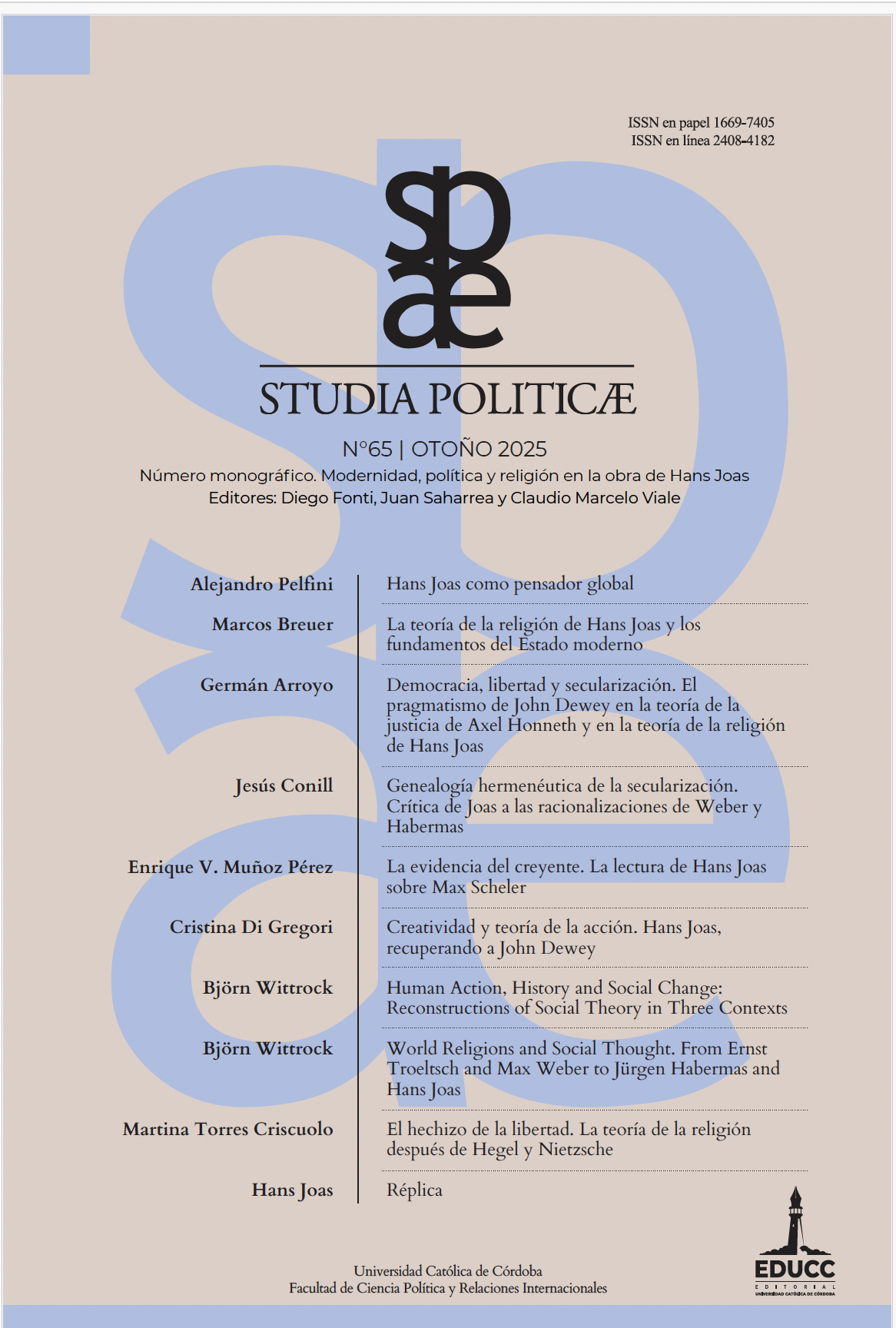
Democracy, Freedom, and Secularization: John Dewey's Pragmatism in Axel Honneth's Theory of Justice and Hans Joas' Theory of Religion
DOI:
https://doi.org/10.22529/Keywords:
pragmatism, german philosophy , hegelianism, ethics, religion, democracyAbstract
The aim of this paper is to address the discussion between two contemporary uses of John Dewey's philosophy: that of Honneth in his Hegelian theory of justice, and that of Joas in his response to the “thesis of the spell of freedom” defended by Honneth in his project. The first and second sections introduce, respectively, the projects of the two authors, pointing out their main theoretical commitments and the incidence of Dewey's philosophy on each project. In the fourth section, each reception is analyzed on the basis of the affinity of the premises of their theoretical-methodological frameworks with Deweyan pragmatism, on the one hand, and the links that each author establishes between Hegel and Dewey in the specific treatment of three elements of the latter's thought, on the other. In the case of Honneth, his interpretation is supported by several scholars from the Anglo-Saxon world who judge that Hegelianism in Dewey makes his democratic philosophical project more intelligible. In the case of Joas, his interpretation of Dewey, while accurate in its anthropological conception, is questionable for placing Dewey's philosophy of religion as a separate chapter of his philosophy (detached from his political and ethical philosophy). It is argued that this severance is a consequence of Joas's anti-Hegelian reading of Dewey, and that this approach is not consistent with the “Hegelian deposit” in the latter's philosophy of religion, which may represent relevant distortions in exegetical terms.Downloads
References
Aboulafia, M., Bookman, M. O. y Kemp, C. (2002). Habermas and Pragmatism. Routledge.
Apel, K.-O. (2016). Der Denkweg von Charles Sanders Peirce. Eine Einführung in den amerikanischen Pragmatismus. Suhrkamp.
Berlin, I. (1969). Four Essays on Liberty. Oxford University Press.
Bernstein, R. J. (1971). Praxis and Action: Contemporary Philosophies of Human Activity. University of Pennsylvania Press.
Bernstein, R. J. (1989). Pragmatism, Pluralism and the Healing of Wounds. Proceedings and Addresses of the American Philosophical Association, 63(3), 5-18. https://doi.org/10.2307/3130079
Bernstein, R. J. (2010). Dewey’s Vision of Radical Democracy. En M. Cochran (Ed.), The Cambridge Companion to Dewey (pp. 288-308). Cambridge University Press.
Beytía, P. (2012). Creatividad situada, contingencia y modernidad. Entrevista a Hans Joas. Andamios, Revista de Investigación Social, 9(19), 361-389. https://doi.org/10.29092/uacm.v9i19.402
Böckenförde, E.-W. (2004). Organ, Organismus, Organisation, politischer Körper. En O. Brunner, W. Konze y R. Koselleck (Eds.), Geschichtliche Grundbegriffe. Historisches Lexikon zur politisch-sozialen Sprache in Deutschland (vol. 4, pp. 519-622). Klett-Cotta.
Colapietro, V. (2009). A Revised Portrait of Human Agency: A Critical Engagement with Hans Joas’s Creative Appropriation of the Pragmatic Approach. European Journal of Pragmatism and American Philosophy, I(1/2). https://doi.org/10.4000/ejpap.961
Dalton, T. C. (2002). Becoming John Dewey: Dilemmas of a Philosopher and Naturalist. Indiana University Press.
Dewey, J. (1972). The Early Works (1882-1898). 5 volumes (Ed. J. A. Boydston). University Press.
Dewey, J. (1973). Lectures in China, 1919-1920. University Press of Hawaii.
Dewey, J. (1976). The Middle Works (1899-1927). 15 volumes (Ed. J. A. Boydston). University Press.
Dewey, J. (1981). The Later Works (1925-1952). 17 volumes (Ed. J. A. Boydston). University Press.
Dewey, J. (1939). Biography of John Dewey. En P. A. Schilpp (Ed.), The Philosophy of John Dewey (pp. 3-45). Open Court.
Dewey, J. (2010). Hegel’s Philosophy of Spirit: 1897, University of Chicago. En J. R. Shook y J. A. Good (Eds.), John Dewey’s Philosophy of Spirit, with the 1897 Lecture on Hegel (pp. 93-176). Fordham University Press.
Dewey, J. (introducción de Alexander, T. M.). (2013). A Common Faith. Yale University Press.
Fesmire, S. (2019). Beyond Moral Fundamentalism: Dewey’s Pragmatic Pluralism in Ethics and Politics. En S. Fesmire (Ed.), The Oxford Handbook of Dewey (pp. 208-234). Oxford University Press. https://doi.org/10.1093/oxfordhb/9780190491192.013.38
Fonti, D. y Viale, C. (2023). Ética del discurso y pragmatismo deweyano: educación en la comunicación democrática. Revista Ética y Discurso, 8. https://qellqasqa.com.ar/ojs/index.php/eyd/article/view/654
Forstenzer, J. (2019). Deweyan Experimentalism and the Problem of Method in Political Philosophy. Routledge.
Garrison, J. (2006). The “Permanent Deposit” of Hegelian Thought in Dewey’s Theory of Inquiry. Educational Theory, 56(1), 1-37. https://doi.org/10.1111/j.1741-5446.2006.00001.x
Gehlen, A. (1997). Der Mensch: Seine Natur und seine Stellung in der Welt. Quelle & Meyer. (Trabajo original publicado en 1962).
Good, J. A. (2006). A Search for Unity in Diversity: The «Permanent Hegelian Deposit» in the Philosophy of John Dewey. Lexington Books.
Good, J. A. (2010). Rereading Dewey’s ‘‘Permanent Hegelian Deposit’’. En J. R. Shook y J. A. Good (Eds.), John Dewey’s Philosophy of Spirit, with the 1897 Lecture on Hegel (pp. 56-92). Fordham University Press.
Habermas, J. (2019). Theorie des kommunikativen Handelns: Band 1: Handlungsrationalität und gesellschaftliche Rationalisierung. Suhrkamp. (Trabajo original publicado en 1981).
Halbig, C. (2018). Hegel, Honneth und das Primat der Freiheit. Kritische Überlegungen. En M. Schlette (Ed.), Ist Selbstverwirklichung institutionalisierbar? Axel Honneths Freiheitstheorie in der Diskussion (pp. 53-72). Campus-Verlag.
Hegel, G. W. F. (1887). Werke. Vols. 1-18 (Ed. P. Marheineke). Duncker und Humblot.
Hegel, G. W. F. (2021). Grundlinien der Philosophie des Rechts oder Naturrecht und Staatswissenschaft im Grundrisse: Mit Hegels eigenhändigen Notizen und den mündlichen Zusätzen. Suhrkamp. (Trabajo original publicado en 1832-1845).
Hegel, G. W. F. (2023). Phänomenologie des Geistes. Suhrkamp. (Trabajo original publicado en 1807).
Honneth, A. (1998a). Between Proceduralism and Teleology: An Unresolved Conflict in Dewey’s Moral Theory. Transactions of the Charles S. Peirce Society, 34(3), 689-711. https://www.jstor.org/stable/40320718
Honneth, A. (1998b). Democracy as Reflexive Cooperation: John Dewey and the Theory of Democracy Today. Political Theory, 26(6), 763-783. https://www.jstor.org/stable/191992
Honneth, A. (2001). The Logic of Fanaticism: Dewey’s Archaeology of the German Mentality. En W. Rehg y J. Bohman (Eds.), Pluralism and the Pragmatic Turn. The Transformation of Critical Theory. The MIT Press.
Honneth, A. (2011). Das Recht der Freiheit: Grundriss einer demokratischen Sittlichkeit. Suhrkamp.
Honneth, A. (2014). El derecho de la libertad: Esbozo de una eticidad democrática. Katz.
Honneth, A. (2015a). Rejoinder. Critical Horizons, 16(2), 204-226. https://doi.org/10.1179/1440991715Z.00000000048
Honneth, A. (2015b). Verdinglichung: Eine anerkennungstheoretische Studie. Suhrkamp. (Trabajo original publicado en 2005).
Honneth, A. (2017). La idea del socialismo. Una tentativa de actualización. Katz.
Honneth, A. (2021). Kampf um Anerkennung: Zur moralischen Grammatik sozialer. Suhrkamp. (Trabajo original publicado en 1992).
Honneth, A. y Joas, H. (1980). Soziales Handeln und menschliche Natur: Anthropologische Grundlagen der Sozialwissenschaften. Campus-Verlag.
Joas, H. (1992a). Die Kreativität des Handelns. Suhrkamp.
Joas, H. (1992b). Pragmatismus und Gesellschaftstheorie. Suhrkamp.
Joas, H. (1997). G. H. Mead: A contemporary re-examination of his thought. MIT Press. (Trabajo original publicado en 1985).
Joas, H. (1999). Die Entstehung der Werte. Suhrkamp. (Trabajo original publicado en 1997).
Joas, H. (2000). The genesis of values. University of Chicago Press.
Joas, H. (2020). Im Bannkreis der Freiheit: Religionstheorie nach Hegel und Nietzsche. Suhrkamp.
Joas, H. (2024). El hechizo de la libertad: La teoría de la religión después de Hegel y Nietzsche (Trad. C. M. Viale, D. O. Fonti y M. Breuer). Sal Terrae.
Johnston, S. (2010). Dewey’s ‘Naturalized Hegelianism’ in Operation: Experimental Inquiry as Self-Consciousness. Transactions of the Charles S. Peirce Society, 46(3), 453-476. https://doi.org/10.2979/tra.2010.46.3.453
Luhmann, N. (1973). Zweckbegriff und Systemrationalität: Über die Funktion von Zwecken in sozialen Systemen. Suhrkamp.
Pappas, G. F. (2012). What would John Dewey say about Deliberative Democracy and Democratic Experimentalism? Contemporary Pragmatism, 9(2), 57-74. https://doi.org/10.1163/18758185-90000230
Parsons, T. (1966). Societies; Evolutionary and Comparative Perspectives. Prentice-Hall.
Rockefeller, S. C. (1991). John Dewey: Religious Faith and Democratic Humanism. Columbia University Press.
Rockmore, T. (2008). Hegel, Idealism, and Analytic Philosophy. Yale University Press. https://doi.org/10.12987/9780300129588
Rondel, D. (2018). Pragmatist Egalitarianism. Oxford University Press.
Ryan, A. (1995). John Dewey and the High Tide of American Liberalism. W.W. Norton.
Saharrea, J., Campeotto, F. y Viale, C. M. (2022). Democracy as Experimentalism and Experimentalism as Anti-Dogmatism: John Dewey and the Theory of Education today. Cognitio: Revista de Filosofia, 23(1), e58434. https://doi.org/10.23925/2316-5278.2022v23i1:e58434
Särkelä, A. (2013). Ein Drama in drei Akten. Deutsche Zeitschrift für Philosophie, 61(5-6), 681-696. https://doi.org/10.1524/dzph.2013.61.56.681
Savage, D. M. (2002). John Dewey’s Liberalism: Individual, Community, and Self-Development. Southern Illinois University Press.
Schaub, J. (2015). Misdevelopments, Pathologies, and Normative Revolutions: Normative Reconstruction as Method of Critical Theory. Critical Horizons, 16(2), 107-130. https://doi.org/10.1179/1440991715Z.00000000043
Selk, V. y Jörke, D. (2020). Back to the Future! Habermas and Dewey on Democracy in Capitalist Times. Constellations, 27(1), 36-49. https://doi.org/10.1111/1467-8675.12423
Shook, J. R. (2000). Dewey’s Empirical Theory of Knowledge and Reality. Vanderbilt University Press.
Shook, J. R. (2004). Deliberative Democracy and Moral Pluralism: Dewey vs. Rawls and Habermas. En J. Ryder y K. Wilkoszewska (Eds.), Deconstruction and Reconstruction: The Central European Pragmatist Forum, Volume Two (pp. 31-41). BRILL.
Shook, J. R. (2010). Dewey’s Naturalized Philosophy of Spirit and Religion. En J. R. Shook y J. A. Good (Eds.), John Dewey’s Philosophy of Spirit, with the 1897 Lecture on Hegel. Fordham University Press.
Westbrook R. (1991). John Dewey and American Democracy. Cornell University Press.
Wood, A. W. (1990). Hegel’s Ethical Thought. Cambridge University Press.
Additional Files
Published
Issue
Section
License
Copyright (c) 2025 Germán Arroyo

This work is licensed under a Creative Commons Attribution-NonCommercial-NoDerivatives 4.0 International License.
How to Cite