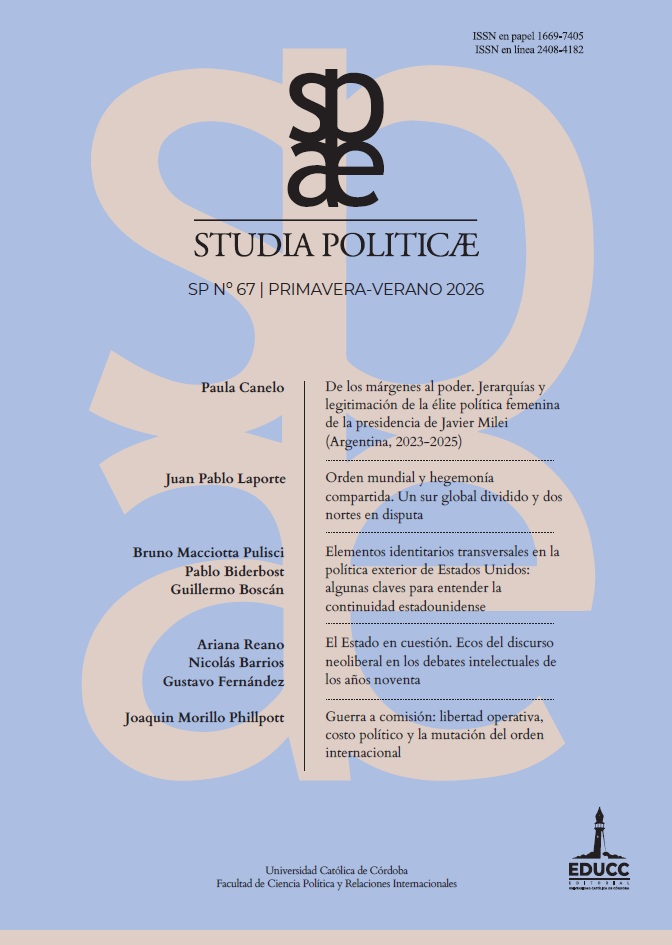
War on Commission: Operational Freedom, Political Cost, and the Mutation of the International Order
DOI:
https://doi.org/10.22529/sp.2026.67.05Keywords:
Private Military Contractors, Outsourcing of Violence, Political Cost, Liberal International Order, Global Governance, Re-privatization of WarAbstract
This essay argues that the operational expansion of Private Military Companies (PMCs) is not merely a technical or isolated phenomenon, but a response by great powers seeking to maximize their freedom of action on the global stage at a low political cost in order to fulfill their respective strategic objectives. With this understanding, the key question is: To what extent does the outsourcing of organized violence by great powers function as a mechanism to reduce the domestic political cost of intervention while simultaneously reconfiguring the norms and institutions of the Liberal International Order (LIO)? The externalization of coercive functions through contracting, subcontracting, and alliances with paramilitary actors allows states to project power with fewer bureaucratic and multilateral restrictions, thus encouraging less transparent operations and less submission to accountability. The essay articulates the categories of political cost, re-privatization of war, and post-Weberian order to interpret the breaks and continuities between PMC operations at the beginning of the 21st century—when the LIO was at its peak—and more contemporary configurations where the legitimacy of this old order appears fractured. The main conclusion is that the externalized privatization of violence not only reduces specific costs for governments but also accelerates a mutation of the LIO toward more realist logics of power in the world.Downloads
References
Bijos, L., & de Souza, R. (2020). Private Military Companies and the outsourcing of war: A spark of destabilisation to the global security. Annales de la Faculté de Droit d’Istanbul, 69, 87–118. https://doi.org/10.26650/annales.2020.69.0004
Singer, P. W. (2005). Outsourcing war. Foreign Affairs, 84(2), 119–132. Council on Foreign Relations. http://www.jstor.org/stable/20034280
Swed, O. (2020). The path to outsourcing security in Southeast Asia. Armed Forces, the State, and Society Series, Working Paper 2. New York University Center for Global Affairs. https://www.researchgate.net/publication/340414670
Swed, O., & Crosbie, T. (2019). Trendlines: Privatization and the future of war and security. En O. Swed & T. Crosbie (Eds.), The sociology of privatized security (pp. 261–279). Palgrave
Macmillan. https://doi.org/10.1007/978-3-319-98222-9_11
Hurrell, A. (2024). Geopolitics and global economic governance. Oxford Review of Economic Policy, 40(2), 220–233. https://doi.org/10.1093/oxrep/grae013
Ikenberry, G. J. (2024). Three Worlds: the West, East and South and the competition to shape global order. International Affairs, 100(1), 121–138. https://doi.org/10.1093/ia/iiad284 Lake, D. A., Martin, L. L., & Risse, T. (2021). Challenges to the Liberal Order: Reflections on International Organization. International Organization, 75(2), 225–257. https://doi.org/10.1017/S0020818320000636
Scahill, J. (2007). Blackwater: The rise of the world's most powerful mercenary army. Nation Books.
Congressional Research Service. (2008). Department of Defense Contractors in Iraq and Afghanistan: Background and Analysis (CRS Report R40764).
Isenberg, D. (2009). Shadow Force: Private Security Contractors in Iraq. Praeger Security
International.
Human Rights Watch. (2021). They Killed Them Like It Was Nothing: The Need for Justice for Crimes Committed by Central African Republic Forces and Russian Paramilitaries.
https://www.hrw.org/report/2021/10/14/they-killed-them-it-was-nothing/need-justice-crimescommitted-central-african
The Sentry. (2021). The Wagner Group: A Proxy Militia for Russia and a Tool for Exploiting
Natural Resources in Africa. https://thesentry.org/reports/wagner-group-russia-africa
Marten, K. (2019). Russia's use of semi-state security forces: The case of the Wagner Group. *Post-Soviet Affairs, 35*(3), 181–204. https://doi.org/10.1080/1060586X.2019.1599622
International Crisis Group. (2024). Haiti’s Last Resort: Gangs and the Prospect of Foreign Intervention (Report No. 94). International Crisis Group. https://www.crisisgroup.org/latinamerica-caribbean/haiti/94-haitis-last-resort-gangs-and-prospect-foreign-intervention Semple, K., & Malkin, E. (2024, 15 de octubre). Haiti’s Next Chapter: An Interview with the
Prime Minister. The New York Times.
https://www.nytimes.com/2024/10/15/world/americas/haiti-prime-minister-interview.html Avant, D. D. (2005). The Market for Force: The Consequences of Privatizing Security. Cambridge University Press.
Swed, O., & Crosbie, T. (Eds.). (2019). The sociology of privatized security. Palgrave Macmillan. https://doi.org/10.1007/978-3-319-98222-9
Singer, P. W. (2003). Corporate Warriors: The Rise of the Privatized Military Industry. Cornell University Press.
Custom Market Insights. (2024). Private military security services market size, trends and insights.https://www.custommarketinsights.com/report/private-military-security-services-market/
Krahmann, E. (2010). States, Citizens and the Privatization of Security. Cambridge University Press.
Clausewitz, C. von (1984). De la guerra. Editorial RBA. (Trabajo original publicado en 1832).
Weber, M. (2012). Economía y sociedad: Esbozo de sociología comprensiva (F. Rubio
Llorente, Trad.). Fondo de Cultura Económica. (Trabajo original publicado en 1922).
Kaldor, M. (1999). New and old wars: Organized violence in a global era. Stanford University Press.
Ludendorff, E. (1935). Der totale Krieg (La Guerra Total). Ludendorffs Verlag.
Münkler, H. (2005). The new wars. Polity Press.
Mueller, J. E. (1973). War, Presidents and Public Opinion. John Wiley & Sons.
Gelpi, C., Feaver, P. D., & Reifler, J. (2006). Success Matters: Casualty Sensitivity and the War in Iraq. International Security, 30(3), 7–46.
Pew Research Center. (2007). Iraq War: Public Opinion. https://www.pewresearch.org/wp-content/uploads/sites/4/legacy-pdf/462.pdf
U.S. Army. (2017). *FM 3-0: Operations*. Department of the Army.
Vines, A. (1999). Mercenaries and the Privatization of Security in Africa. Brown Journal of World Affairs, 6(2), 193–201.
Medium. (2023). Blackwater: The Rise and Fall of a Private Army.
BBC News. (2024, February 13). Wagner Group in Central African Republic: What is the Russian mercenary group up to now? https://www.bbc.com/news/world-africa-68322230
DW News. (2024, 18 março). Como o Grupo Wagner atua em prol dos interesses russos na
África. https://www.dw.com/pt-br/como-o-grupo-wagner-atua-em-prol-dos-interesses-russosna-áfrica/a-70619142
Znak. (2018, 5 de marzo). Как выглядит лагерь ЧВК Вагнера в Краснодаре [How the
Wagner PMC camp in Krasnodar looks]. Archivo de Internet. Recuperado 23 de mayo de 2024, de https://web.archive.org/web/20180309065754/https://www.znak.com/2018-0305/kak_vyglyadit_lager_chvk_vagnera_v_krasnodare
Partlow, J. (2006, December 5). U.S. Citizens' Ranks Thin in Iraq's Civilian Police Training.
The Washington Post. https://www.washingtonpost.com/wpdyn/content/article/2006/12/04/AR2006120401311.html
RIA Novosti. (2022, December 22). Минобороны РФ сообщило об окончании совместных с бойцами ЧВК Вагнера учений в российских полигонах [The Russian Defense Ministry announced the completion of joint exercises with Wagner PMC fighters at Russian training grounds]. https://ria.ru/20221222/ucheniya-1839955827.html
Russian Defense Ministry. (2022, July 4). Appeal to the fighters of the Wagner Private Military Company [Archived press release]. Internet Archive. Retrieved May 23, 2024, from
https://web.archive.org/web/20220704145612/https://syria.tv/
TASS. (2023, June 27). Russian Defense Ministry says Wagner Group's fighters prepared weapons, military hardware for combat drills. https://tass.com/defense/1638815
Wikipedia. (2024, May 22). Wagner Group. In Wikipedia. Retrieved May 23, 2024, from https://en.wikipedia.org/wiki/Wagner_Group#Relationship_with_the_Russian_state Reuters. (2024, February 2). Russia's Wagner group exported $2.5 billion in African gold, says EU. Reuters.
https://www.reuters.com/world/europe/russias-wagner-group-exported-25-billion-african-goldsays-eu-2024-02-02/
Ikenberry, G. J. (2011). Liberal Leviathan: The origins, crisis, and transformation of the American world order. Princeton University Press.
Ikenberry, G. J. (2018). The end of liberal international order? International Affairs, 94(1), 7–23. https://doi.org/10.1093/ia/iix241
O'Donnell, G. (2004). The quality of democracy: Why the rule of law matters. Journal of Democracy, 15(4), 32–46. https://doi.org/10.1353/jod.2004.0076
Dahl, R. A. (1971). Polyarchy: Participation and opposition. Yale University Press.
Bátora, J. (2021). States, interstitial organizations and the prospects for liberal international order. International Affairs, 97(5), 1433–1450. https://doi.org/10.1093/ia/iiab108
Ackerson, M. (2025). Haiti's Vectus gamble: Private force and private customs in a failing state. https://international-and-comparative-law-review.law.miami.edu/haitis-vectus-gamble-private-force-and-private-customs-in-a-failing-state/
Additional Files
Published
Issue
Section
License
Copyright (c) 2026 Joaquín Morillo Phillpott

This work is licensed under a Creative Commons Attribution-NonCommercial-NoDerivatives 4.0 International License.
How to Cite