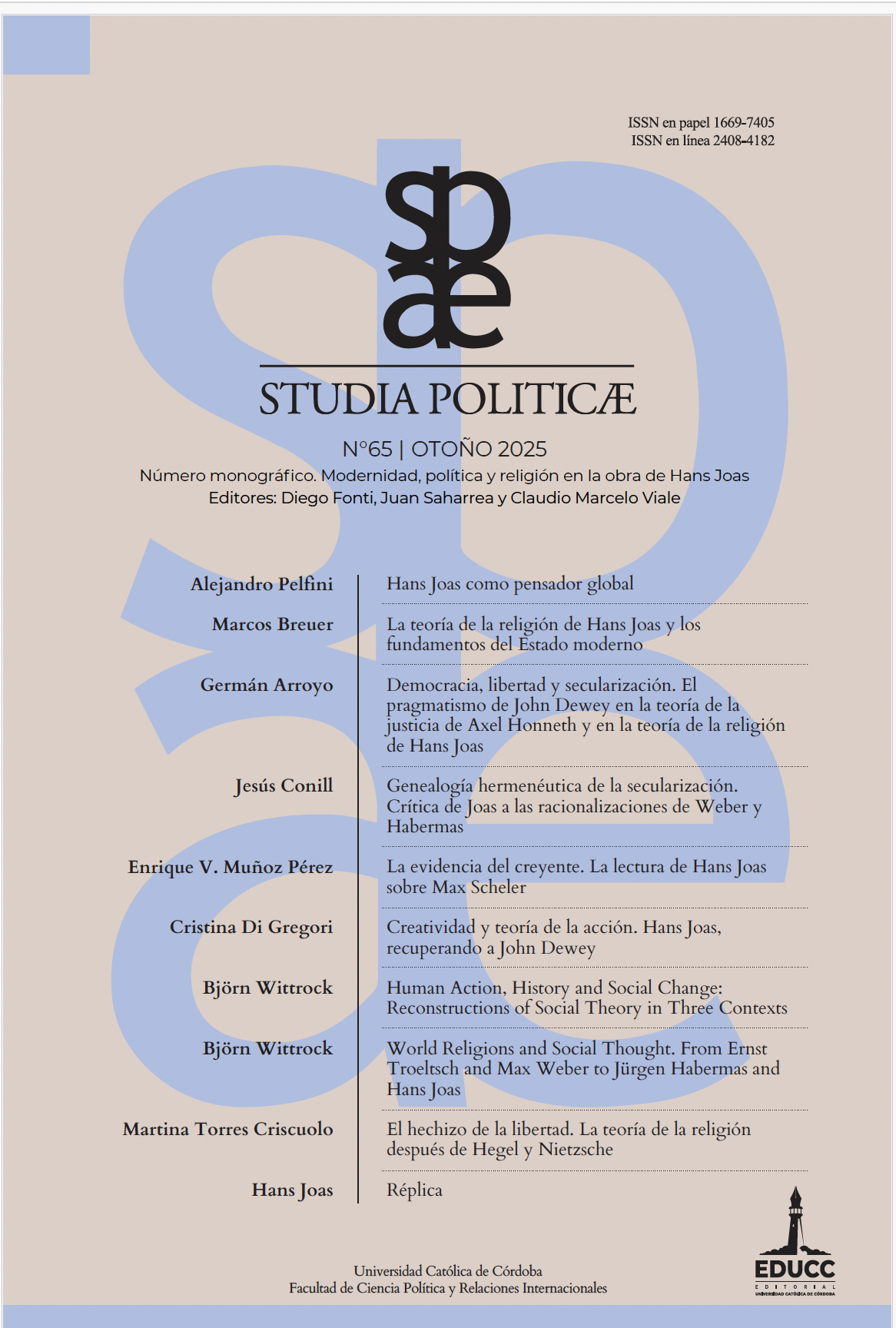
Human Action, History and Social Change: Reconstructions of Social Theory in Three Contexts
DOI:
https://doi.org/10.22529/Palavras-chave:
Hughes, social, theory, action, Joas, naturalismResumo
This text appeared in German in a Festschrift —a collection of essays written to honour and in celebration of an eminent Scholar— to Professor Hans Joas on the occasion of his 60th birthday in 2010. It compares Stuart Hughes’ (1958) monograph Consciousness and Society: The Reconstruction of European Social Thought, 1890-1930 with Die Kreativität des Handelns [The Creativity of Action] by Hans Joas (1992). Since Hughes’s development can be paralleled with Talcott Parsons's contributions (especially the conviction that the reflection on human action is fundamental for a new social theory) and given that Joas’s critique of Parsons is key to his view on social theory, this paper points out a promising dialogue between Joas and Hughes that is not straightforwardly developed in former’s work. It starts out by analysing the basic structure of two of the most outspoken and polemical versions of a naturalist and an anti-naturalist account of human action that appeared in the years Hughes published his book. It then moves on to consider how the dilemmas, which were identified in the wake of the debates at mid-century, stand out in our own era in two versions of social theorizing and thought that have emerged out of an analytical-empiricist and a linguistic-interpretive tradition respectively. It argues both these current orientations have successfully overcome several of the shortcomings characteristic of earlier positions. These present-day orientations mark genuine scholarly advances in elaborating an action-based social science. In this context, It also repeatedly calls attention to works by Hans Joas and tries to indicate that they are characterized by strategic choices that hold out the promise for a social science that will be more consistently action-based but also more consistently historically reflective than anything that has existed since the age of profound reconstruction of social thought that forms the subject of Hughes’s Consciousness and Society.Downloads
Referências
Bellah, R. N. (2005). What is axial about the Axial Age? European Journal of Sociology / Archives Européennes de Sociologie, 44(1), 69-89. https://doi.org/10.1017/S0003975603000012
Downs, A. (1957). An Economic Theory of Democracy. Harper & Row.
Collingwood, R. G. (1946). The Idea of History. Oxford University Press.
Eisenstadt, S. N. (2005). Die Achsenzeit in der Weltgeschichte in H. Joas & K. Wiegand (Eds.), Die kulturellen Werte Europas (pp. 40-68). Suhrkamp.
Hempel, C. G. (1942). The Function of General Laws in History. The Journal of Philosophy, 39(2), 35-48. https://doi.org/10.2307/2017635
Hempel, C. G. (1959). The Logic of Functional Analysis in L. Gross (Ed.), Symposium on Sociological Theory (pp. 271-307). Harper & Row.
Hempel, C. G. (1962). Deductive-Nomological vs. Statistical Explanation in H. Feigl and G. Maxwell (Eds.), Minnesota Studies in the Philosophy of Science (Vol. III, pp. 98-169). University of Minnesota Press. https://hdl.handle.net/11299/184632
Hempel, C. G. (1965). Aspects of Scientific Explanation and Other Essays in the Philosophy of Science. Free Press.
Hedström, P. (2005). Dissecting the Social: On the Principles of Analytical Sociology. Cambridge University Press. https://doi.org/10.1017/CBO9780511488801
Hedström, P. (2009). The Analytical Turn in Sociology in P. Hedström & B. Wittrock (Eds.), Frontiers of Sociology (pp. 331-342). Brill.
Hedström, P. & Bearman, P. (Eds.). (2009). The Oxford Handbook of Analytical Sociology. Oxford University Press.
Hedström, P. & Swedberg, R. (Eds.). (1998). Social Mechanisms: An Analytical Approach to Social Theory. Cambridge University Press. https://doi.org/10.1017/CBO9780511663901
Hughes, H. S. (1958). Consciousness and Society: The Reconstruction of European Social Thought, 1890-1930. Knoft.
Hughes, H. S. (1975). The Sea Change: The Migration of Social Thought, 1930-1965. Harper.
Jaspers, K. (1949). Vom Ursprung und Ziel der Geschichte. Artemis.
Joas, H. (1992). Die Kreativität des Handelns. Suhrkamp.
Joas, H. (1997). Die Entstehung der Werte. Suhrkamp.
Joas, H. (2000). Kriege und Werte. Studien zur Gewaltsgeschichte des 20. Jahrhunderts. Velbrück Wissenschaft.
Joas, H. (2004). Braucht der Mensch Religion? Über Erfahrungen der Selbsttranszendenz. Herder.
Joas, H. & Knöbl W. (2008). Kriegsverdrängung. Ein Problem in der Geschichte der Sozialtheorie. Suhrkamp.
Joas, H. & Wiegand, K. (Eds.). (2005). Die kulturellen Werte Europas. Verlag.
Joas, H. & Wiegand, K. (Eds.). (2007). Säkulariesierung und die Weltreligionen. Suhrkamp.
Lepenies, W. (1985). Die drei Kulturen. Soziologie zwischen Litteratur und Wissenschaft. Hanser.
Meinecke, F. (1946). Die deutsche Katastrophe. Europa Verlag.
Parsons, T. (1937). The Structure of Social Action. McGraw-Hill Book Company.
Palonen, K. (2003). Quentin Skinner: History, Politics, Rethoric. Polity.
Rudner, R. S. (1966). Philosophy of Social Science. Prentiss Hall.
Skinner, Q. (1978). The Foundations of Modern Political Thought. Volume One: The Renaissance. Cambridge University Press
Skinner, Q. (1996). From Hume’s Intentions to Deconstruction and Back. The Journal of Political Philosophy, 4(2), 142-154. https://doi.org/10.1111/j.1467-9760.1996.tb00046.x
Skinner, Q. (2002). Visions of Politics. Volume 1: Regarding Method. Cambridge University Press. https://doi.org/10.1017/CBO9780511790812
Von Wright, G. H. (1971). Explanation and Understanding. Routledge & Kegan Paul.
Winch, P. (1958). The Idea of a Social Science and its Relation to Philosophy. Routledge & Kegan Paul.
Winch, P. (Ed.). (1969). Studies in the philosophy of Wittgenstein. Routledge & Kegan Paul.
Arquivos adicionais
Publicado
Edição
Seção
Licença
Copyright (c) 2025 Björn Wittrock

Este trabalho está licenciado sob uma licença Creative Commons Attribution-NonCommercial-NoDerivatives 4.0 International License.
Como Citar