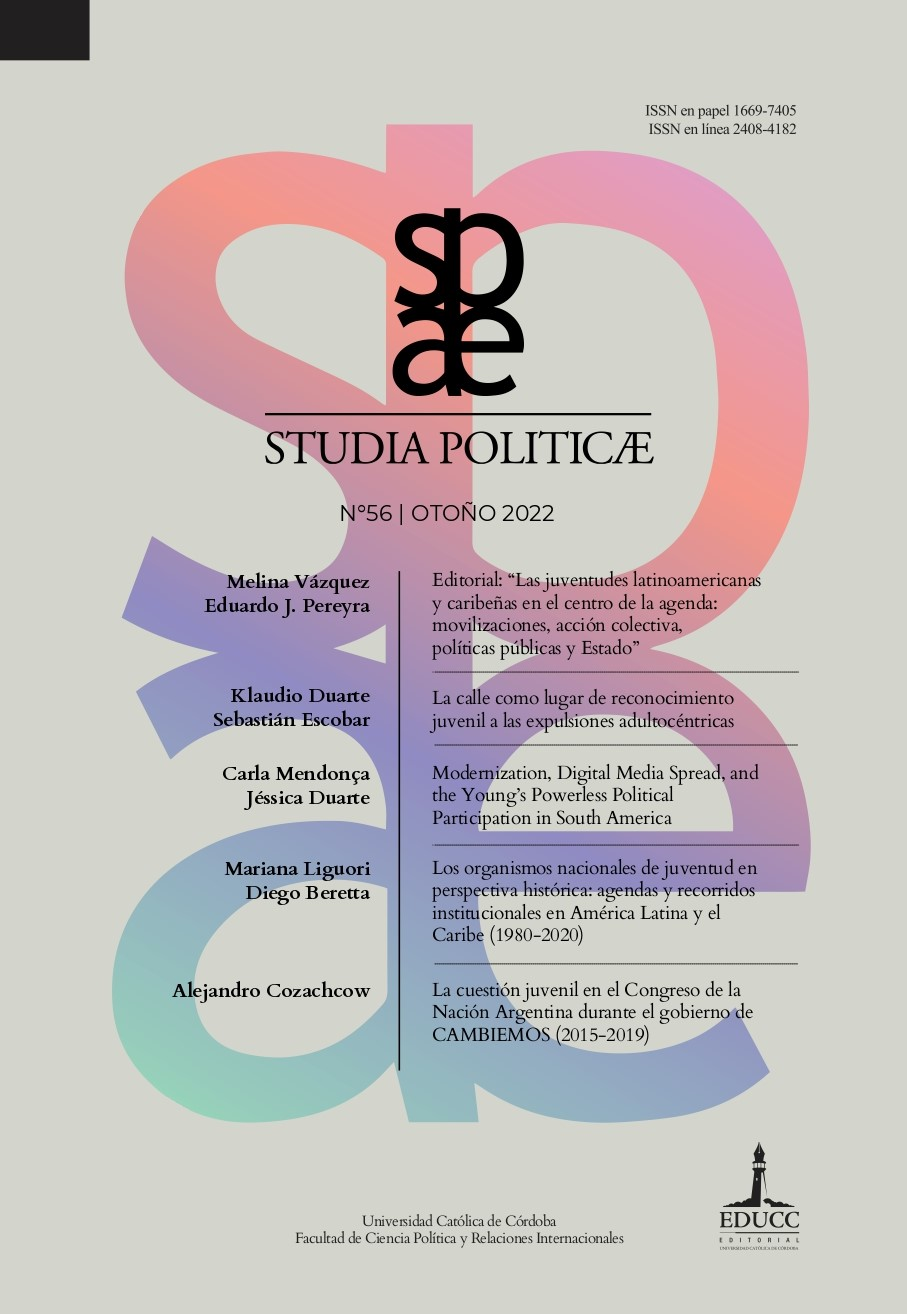
Modernisation, Digital Media Spread, and the Youngs Powerless Political Participation in South America
DOI:
https://doi.org/10.22529/sp.2022.56.03Keywords:
actitudes democráticas - participación política - medios de comunicación digitales - jóvenes de América del Sur - WVSAbstract
Este artículo presenta un estudio longitudinal sobre las actitudes democráticas y la participación política de los jóvenes sudamericanos a lo largo delproceso de crecimiento del uso de los medios digitales en la región. Se ha probado la asociación entre sus valores democráticos y su comportamientopolítico desde la década de 1980 y el creciente acceso a los medios digitales desde la década de 1990. Se analizaron los cuarenta años de la basede datos de la Encuesta Mundial de Valores (WVS). Identificamos que los jóvenes de Argentina, Brasil, Chile, Colombia, Ecuador, Perú y Uruguayno se han vuelto más democráticos y muestran niveles bajos y estables de participación política a lo largo del aumento de los índices de desarrollosocioeconómico y la difusión de los medios digitales en sus países.Downloads
References
Agudelo-Ramírez, A., Murillo-Saa ?, L., Echeverr y-Restrepo, L. y Patin?o-Lo?pez, J. A. (2013). Participacio?n ciudadana y pra?cticas poli?ticas de jo?venes en la cotidianidad. Revista Latinoamericana de Ciencias Sociales, Nin?ez y Juventud, 11(2), 587-602.
Almond, G. y Verba, S. (1989). The Civic Culture: Political attitudes and democracy in five nations. SAGE.
Arias-Cardona, A. M. y Alvarado, S. V. (2015). Jo?venes y poli?tica: de la participacio?n formal a la movilizacio?n informal. Revista Latinoamericana de Ciencias Sociales, Nin?ez
y Juventud, 13(2), 581-594.
Baquero, M. (2011). Cultura(s) Política(s) e democracia no Século XXI na América Latina. Editora da UFRGS.
Baquero, M. y Baquero, R. (2012). Novos padrões de participação política dos jovens na democracia brasileira?. Em Debate (8), 19-25.
Baquero, M., Baquero, R. y Morais J. A. (2016). Os jovens estão mais assertivos politicamente no Brasil? Uma análise da cultura política. Revista Debates, 10(2), 71-94.
https://doi.org/10.22456/1982-5269.67295
Baquero, M., Bernardi, A. J. y Morais, J. A. (2019). Padrões emergentes de uma cultura política juvenil no sul do Brasil. Revista Eletrônica do Programa de Pós-Graduação
da Câmara dos Deputados, 12(28), 42-63. https://doi.org/10.51206/e-legis.v12i28.440
Baquero, M. y Morais, J. A. (2014). Padrões de comportamento político juvenil com novas tecnologias de mídia: o papel da tv e da internet na construção da cultura política no
Brasil. Tempo da Ciência (UNIOESTE), 21(42), 69-84. https://e-revista.unioeste.br/index.php/tempodaciencia/article/view/12627
Baquero, M. y Morais, J. A. (2018). Está em andamento a construção de uma nova cultura política juvenil?. In M. Baquero (Org.), A juventude e os desafios da construção da
democracia no Brasil (17-66). Escritos. Bartlett, J. (2014). Populism, social media and democratic strain. In Clara Sandelind (Ed)
European populism and winning the immigration debate, 99-114.
Barnes, S. H., and Max Kaase. 1979. Political action: Mass participation in five Western democracies. Beverly Hills, Calif: Sage Publications.
Bennett, W. L., Wells, C. y Freelon, D. (2011). Communicating Civic Engagement: contrasting models of citizenship in the youth web sphere. Journal of Communication,
(5), 835856. https://doi.org/10.1111/j.1460-2466.2011.01588.x
Bradshaw, S. y Howard, P. N. (2019). Social media and democracy in crisis. Society and the internet: How networks of information and communication are changing our lives,
-227.
Brussino, S., Rabbia, H. H. y Sorribas, P. (2009). Perfiles sociocognitivos de la participación política de los jóvenes. Interamerican Journal of Psychology, 43(2), 279-287.
Castro, L. (2009). Juventude e Socialização Política: atualizando o debate. Psicologia: Teoria e Pesquisa, 25(4), 479-487. https://doi.org/10.1590/S0102-37722009000400003
Cohen, C. y Kahne, J. (2012). Participatory Politics: new media and youth political action.
MacArthur Foundation.
Fuchs, C. (2017). Social media: A critical introduction (2nd. ed.). Sage.
Graaf, N. D. D. y Evans, G. (1996). Why are the Young more Postmaterialist?: A Cross-National Analysis of Individual and Contextual Influences on Postmaterial Values. Comparative Political Studies, 28(4), 608635. https://doi.org/10.1177/0010414096028004005
Grasso, M. T. (2014). Age, period and cohort analysis in a comparative context: Political generations and political participation repertoires in Western Europe. Electoral Studies, 33, 6376. https://doi.org/10.1016/j.electstud.2013.06.003
Hernández-Sampieri, R., Fernández Collado, C. y Baptista Lucio, M. P. (2018). Metodología de la investigación. McGraw-Hill Interamericana.
Herrera, L. (2012). Youth and Citizenship in the Digital Age: a view from Egypt. Harvard Educational Review, 82(3), 333-352. https://doi.org/10.17763/haer.82.3.
r117u710300
Inglehart, R. (2008). Changing Values among Western Publics from 1970 to 2006. West European Politics, 31(1-2), 130-146. https://doi.org/10.1080/01402380701834747
Inglehart, R. y Welzel, C. (2009). Modernização, Mudança Cultural e Democracia: a sequência do desenvolvimento humano. Francis.
Kaase, M. (2010). Democracy and Political Action. International Political Science Review, 31(5), 539551. https://doi.org/10.1177/0192512110388787
Kaase, M. y Marsh, A. (1979a). Political action. A theoretical perspective. In S.H. Barnes and M. Kaase (Eds), Political Action: Mass Participation in Five Western Democracies
(pp. 2756). Sage.
Krischke, P. J. (2004). Perfil da Juventude Brasileira: questões sobre cultura política e participação democrática. Revista Internacional Interdisciplinar Interthesis, 1(2), 1-27.
Mannheim, K. (1928). The Problem of Generations: Essays on the Sociology of Knowledge. Routledge.
Mill, J. S. (1886). A system of logic ratiocinatively and inductive. Longmans, Green and Co.
Morelock, J. y Narita, F. (2021). The society of the selfie: social media and the crisis of liberal democracy. University of Westminster Press.
Muñoz, G. (2012). De las culturas juveniles a las ciberculturas del siglo XXI. Teología y Sociedad, (9). https://revistas.javerianacali.edu.co/index.php/teologiaysociedad/article/
view/368
Niemi, R. G. y Sobieszek, B. I. (1977). Political Socialization. Annual Review of Sociology, 3, 209233. Annual Reviews.
Niemi, R. y Hepburn, M. A. (1995). The rebirth of political socialization. Perspectives on Political Science, 24(1), 7-16. https://www.uvm.edu/~dguber/POLS234/articles/niemi.
Pérez Islas, J. A. (2006). Trazos para un mapa de la investigación sobre juventud en América Latina. Revista de Sociologia [S.l.], 79, 145-170. http://dx.doi.org/10.5565/rev/
papers/v79n0.829
Putnam, R. (2001). Bowling Alone: the collapse and revival of American community. Simon and Schuster.
Quintelier, E. y Van Deth, J. W. (2014). Supporting Democracy: Political Participation and Political Attitudes. Exploring Causality Using Panel Data. Political Studies,
(S1), 153171. https://doi.org/10.1111/1467-9248.12097
United Nations Department of Economic and Social Affairs. (2013). Definition of Youth. https://www.un.org/esa/socdev/documents/youth/fact-sheets/youth-definition.pdf
United Nations Development Programme. (2020). Human Development Reports. http:// hdr.undp.org/en/content/human-development-index-hdi.
Vaccari, C. y Valeriani, A. (2021). Outside the Bubble: Social Media and Political Participation in Western Democracies. Oxford University Press.
Van der Meer, T. W. G., Van Deth, J. W. y Scheepers, P. L. H. (2009). The Politicized Participant: Ideology and Political Action in 20 Democracies. Comparative Political
Studies, 42(11), 14261457. https://doi.org/10.1177/0010414009332136
Verba, S. y Nie, N. H. (1987). Participation in America: Political democracy and social equality. University of Chicago Press.
Zarzuri, R. (2010). Tensiones y desafíos en la participación política juvenil en Chile. Utopía y Praxis Latinoamericana, 15(50), 103-115.
Published
Issue
Section
License
Copyright (c) 2022 Studia Politicæ

This work is licensed under a Creative Commons Attribution-NonCommercial-NoDerivatives 4.0 International License.
How to Cite