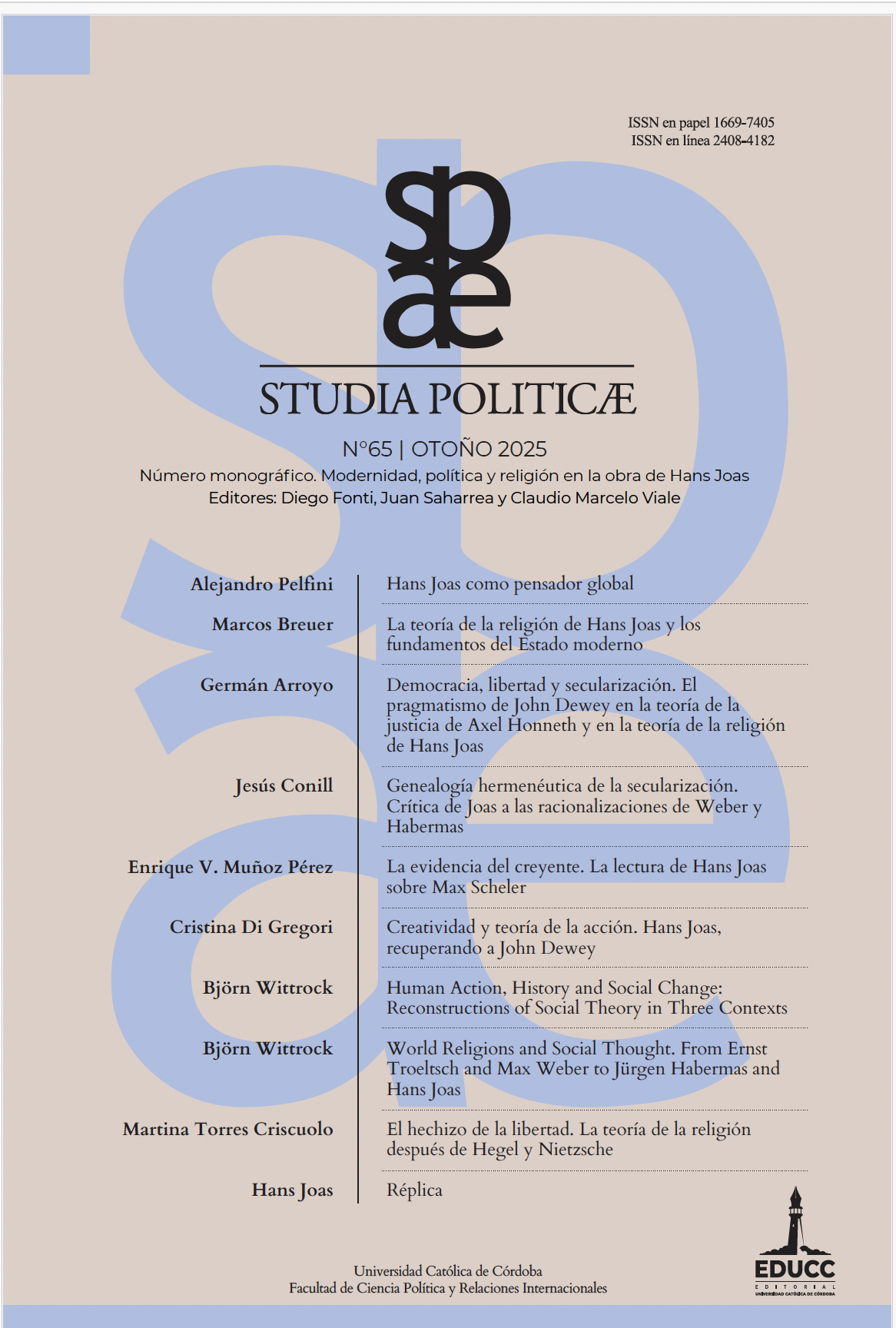
Religiones del mundo y pensamiento socialDesde Ernst Troeltsch y Max Weber a Jürgen Habermas y Hans Joas
DOI:
https://doi.org/10.22529/Palabras clave:
religiones mundiales, teoría social, modernidad, secularización, trascendenciaResumen
Este trabajo fue escrito con ocasión del festejo de los 70 años de Hans Joas, y publicado en alemán en el libro editado por M. Schlette, B. Hollstein, M. Jung and W. Knobl (2022), con el título Idealbildung, Sakralisierung, Religion. Beiträge zu Hans Joas’ Die Macht des Heiligen. Después de resaltar las contribuciones de la filosofía social de Joas, Wittrock muestra los principales rasgos de la historia de la teoría social con relación a la investigación científica de las religiones mundiales. Esta reconstrucción ubica en cada contexto histórico las preguntas que se hicieron y las respuestas que se proveyeron, mientras que al mismo tiempo identifica algunas preguntas persistentes, tales como el lugar y el rol de las religiones mundiales en comparación con otros fenómenos religiosos, o respecto de la relación entre cristianismo y modernidad. Además, un aporte central de este artículo es la reconstrucción de las interpretaciones sociológicas y filosóficas de la era axial. Después de estas partes preparatorias y reconstructivas, Wittrock enfoca su análisis en las obras hasta ese momento más recientes de Habermas y Joas relacionadas con la era axial, para mostrar sus tensiones y capacidades inherentes frente a las experiencias actuales de secularización y trascendencia.Descargas
Referencias
Arjomand, S. A. (2004). Transformations of the Islamicate Civilization. In Johann P. Arnason and Björn Wittrock (Eds.), Eurasian Transformations, Tenth to Thirteenth Centuries: Crystallizations, Divergences, Renaissences (pp. 213-245). Brill.
Arnason, J. P. (2003). Civilizations in Dispute: Historical Questions and Theoretical Traditions. Brill.
Arnason, J. P. (2004). The Axial Age and Its Interpreters: Reopening a Debate. In J. P. Arnason, S. N. Eisenstadt, & B. Wittrock (Eds.), Axial Civilizations and World History. Brill.
Arnason, J. P., Eisenstadt, S. N., & Wittrock, B. (Eds.). (2005). Axial civilizations and world history. Brill.
Bellah, R. N. (2005). What is Axial About the Axial Age? European Journal of Sociology, 46(1), 69–89. https://doi.org/10.1017/S0003975605000032
Bellah, R. N. (2011). Religion in Human Evolution: From the Paleolithic to the Axial Age. Belknap Press.
Bellah, R. N., & Joas, H. (2012). The Axial Age and its Consequences. Belknap Press.
Daedalus. (1975). Daedalus, 104(2). https://www.jstor.org/stable/20024323
Donald, M. (1991). Origins of the modern mind: Three stages in the evolution of culture and cognition. Harvard University Press.
Eisenstadt, S. N. (1963). The Political Systems of Empires. The Free Press of Glencoe.
Eisenstadt, S. N. (1986). The Origins and Diversity of Axial Age Civilizations. State University of New York Press.
Eisenstadt, S. N. (Ed.). (1987). Kulturen der Achsenzeit I: Ihre Ursprünge und ihre Vielfalt, Teil 1: Griechenland, Israel, Mesopotamien. Teil 2: Spätantike, Indien, China, Islam. Suhrkamp.
Eisenstadt, S. N. (Ed.). (1992). Kulturen der Achsenzeit II: Ihre institutionelle und kulturelle Dynamik, Teil 1: China, Japan. Teil 2: Indien. Teil 3: Buddhismus, Islam, Altägypten, westliche Kultur. Suhrkamp.
Eisenstadt, S. N. (1996). Japanese Civilization: A Comparative View. University of Chicago Press.
Eisenstadt, S. N. (1999). Fundamentalism, Sectarianism, and Revolution: The Jacobin Dimension of Modernity. Cambridge University Press.
Eisenstadt, S. N. (2005). The Great Revolutions and the Civilizations of Modernity. Brill.
Eisenstadt, S. N., Arnason, J. P., & Wittrock, B. (2005). Axial Civilizations and World History. Brill.
Habermas, J. (2019). Auch eine Geschichte der Philosophie (vols. 1 & 2). Suhrkamp.
Heilbron, J., Wittrock, B., & Magnusson, L. (Eds). (2001). The Rise of the Social Sciences and the Formation of Modernity: Conceptual Change in Context, 1750-1850. Springer.
Hughes, H. S. (1958). Consciousness and Society: The Reorientation of European Social Thought, 1890-1930. Knopf.
Jaspers, K. (1953). The Origin and Goal of History. Yale University Press.
Joas, H. (1996). The Creativity of Action. Polity Press. (Original work published in 1992).
Joas, H. (2001). The Genesis of Values. University Chicago Press. (Original work published in 1997).
Joas, H. (2013). The Sacredness of the Person: A New Genealogy of Human Rights. Georgetown University Press. (Original work published in 2011).
Joas, H. (2017). Die Macht des Heiligen: Eine Alternative zur Geschichte von der Entzauberung. Suhrkamp.
Joas, H. & Knöbl, W. (2009). Social Theory: Twenty Introductory Lectures (A. Skinner, Trans.). Cambridge University Press. (Original work published in 2004).
Kuenen, A. (1883). Volksreligion und Weltreligion: Fünf Hibbert-Vorlesungen. Reimer.
Marchand, S. L. (2009). German Orientalism in the Age of Empire: Religion, Race, and Scholarship. Cambridge University Press.
Pankenier, D. W. (2013). Astrology and cosmology in early China: Conforming earth to heaven. Cambridge University Press.
Parson, T. (1966). Societies: Evolutionary and Comparative Perspectives. Prentice Hall.
Pommeranz, K. (2000). The Great Divergence: China, Europe, and the Making of the Modern World Economy. Princeton University Press.
Puett, M. J. (2001). The Ambivalence of Creation: Debates Concerning Innovation and Artifice in Ancient China. Stanford University Press.
Puett, M. J. (2002). To Become a God: Cosmology, Sacrifice and Self-Divination in Early China. Harvard University Asia Center for the Harvard-Yenching Institute.
Schluchter, W. (1996). Paradoxes of Modernity: Culture and Conduct in the Theory of Max Weber. Stanford University Press.
Schluchter, W. (1998). Die Entstehung des modernen Rationalismus: Eine Analyse von Max Webers Entwicklungsgeschichte des Okzidents. Suhrkamp.
Schluchter, W. & Graf, F. W. (Eds.). (2005). Asketischer Protestantismus und der ‘Geist’ des modernen Kapitalismus. Moor Siebeck.
Stroumsa, G. G. (2018). Anquetil Duperron et les origines de la philologie orientale: l'orientalisme est un humanisme. ASDIWAL. Revue genevoise d'anthropologie et d'histoire des religions, (13), 161-174.
Taylor, C. (2007). A Secular Age. Harvard University Press.
Troeltsch, E. (1923). Die Soziallehren der cristlichen Kirchen und Gruppen. Mohr Siebeck. (Original work published in 1912).
Troeltsch, E. (1924). Der Historismus und seine Überwindung: Fünf Vorträge von Ernst Troeltsch. Pan Verlag Rolf Heise.
Weber, M. (1978). Gesammelte Aufsätze zur Religionssoziologie. Mohr Siebeck.
Weber, M. (1991a). Nachwort des Herausgebers, 1. Das Interesse an den Weltreligionen am Vorabend des Ersten Weltkrieges und das Problem der Wirtschaftsethik. In Max Weber-Gesamtausgabe: Band I/19: Die Wirtschaftsethik der Weltreligionen. Konfuzianismus und Taoismus. Schriften 1915-1920. Mohr Siebeck.
Weber, M. (1991b). Gesammelte Aufsätze zur Wissenschaftslehre (vols. 1-3). Mohr Siebeck.
Publicado
Número
Sección
Licencia
Derechos de autor 2025 Björn Wittrock

Esta obra está bajo una licencia internacional Creative Commons Atribución-NoComercial-SinDerivadas 4.0.
Cómo citar