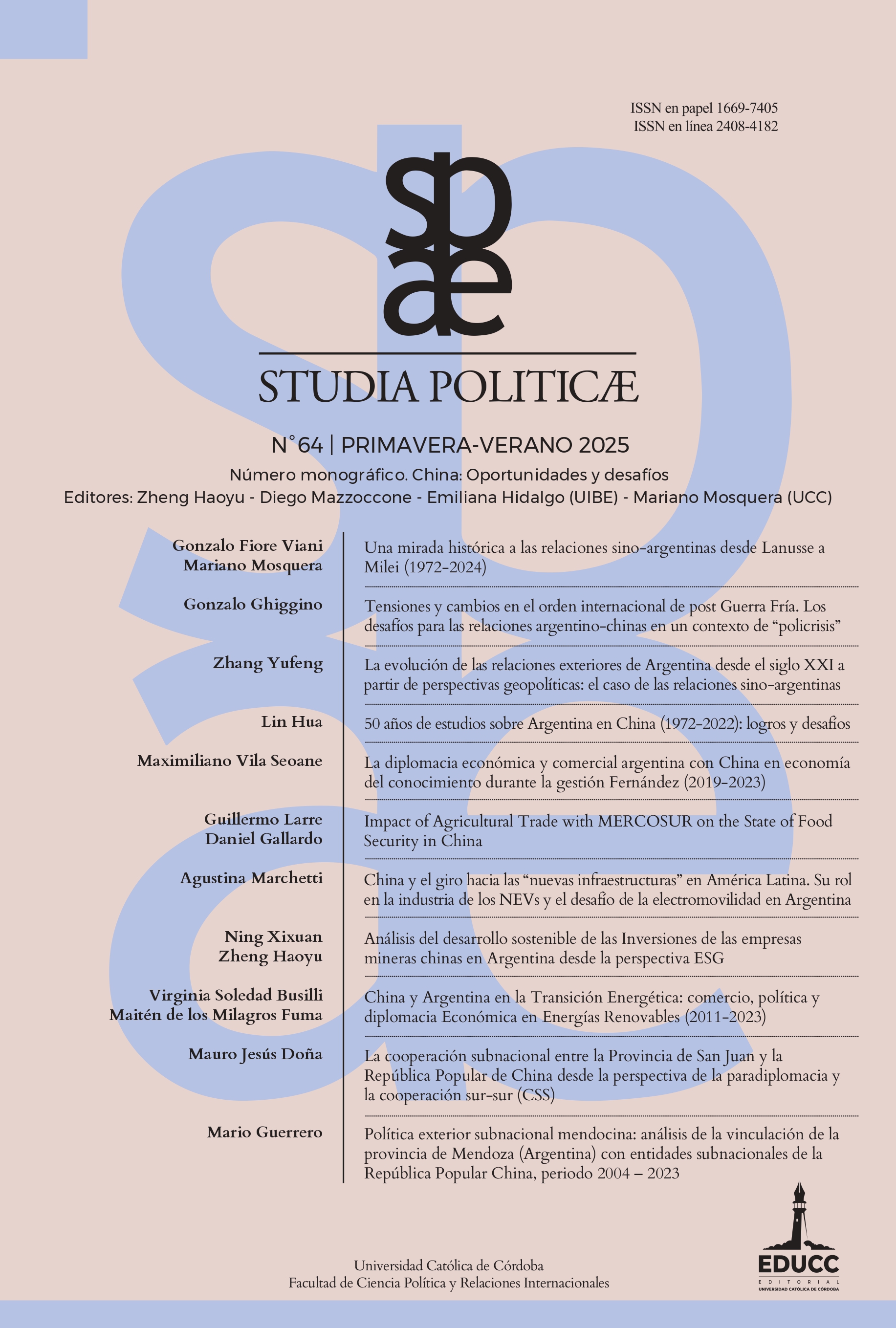
"Impacto del Comercio Agrícola con el MERCOSUR en el Estado de Seguridad Alimentaria de China"
DOI:
https://doi.org/10.22529/Palabras clave:
comercio agrícola, seguridad alimentaria, soja, transmisión horizontal de precios, traspaso internacional de preciosResumen
Este artículo tiene como objetivo demostrar que las exportaciones de productos agrícolas desde los países del MERCOSUR hacia China tienen un efecto significativo en el estado de la seguridad alimentaria en China. Los países del MERCOSUR se han convertido en proveedores clave de varios productos agrícolas para China, especialmente soja y carne vacuna. Esto sugiere que los países del MERCOSUR podrían desempeñar un papel importante en el suministro de proteínas para la población china. Nos enfocamos en dos dimensiones de la seguridad alimentaria en China: disponibilidad y acceso. Utilizamos un modelo basado en regresión lineal para demostrar que el comercio con los países del MERCOSUR explica el 8,29% del suministro total de proteínas, o 10,42 gramos por persona al día, en China continental, explicado principalmente por el comercio de soja con Brasil. Luego, utilizamos un modelo de cointegración para demostrar que los precios internacionales de la soja están integrados entre sus principales importadores, China y la UE, y sus principales exportadores, Brasil, Estados Unidos y Argentina. Esto muestra que existe una conexión estable entre los precios internacionales de este producto, lo cual tiene un efecto en los costos asociados con las políticas de estabilidad de precios de los alimentos en China. Finalmente, utilizamos IRF para encontrar que los precios de exportación de soja de Brasil tienen un efecto retardado y permanente en los precios de importación de ese producto en China. Un aumento del 1% en el precio de exportación de soja en Brasil puede esperarse que produzca un aumento del 0,32% en el precio de importación en China después de un mes y un aumento permanente del 2,8% después de aproximadamente 8 meses. Estos resultados ayudan a informar a las políticas y los estudios sobre seguridad alimentaria y comercio internacional en China y el MERCOSUR.Descargas
Referencias
Barboza Martignone, G., Behrendt, K., & Paparas, D. (2022). Price transmission analysis of the international soybean market in a trade war context. Economies, 10(8), 203.
Coughlin, A., & Sutton-Vermeulen, D. (2020). The relationship between global soybean prices and local markets. CME Group. https://www.cmegroup.com/education/articles-and-reports/ relationship-between-global-soybean-prices.html
Fackler, P. L., & Goodwin, B. K. (2001). Spatial price analysis. In B. L. Gardner & G. C. Rausser (Eds.), Handbook of agricultural economics (Vol. 1, pp. 971–1024). Elsevier.
Guvheya, G., Mabaya, E. T., & Christy, R. D. (1998). Horticultural marketing in Zimbabwe: Margins, price transmission, and spatial market integration (Staff Paper No. SP 98-02). Cornell University.
Kenen, P. B., & Pack, C. (2008). Exchange rates, domestic prices and the adjustment process: A survey of recent evidence (Occasional Paper No. 1). Group of Thirty.
Kirchgässner, G., & Kübler, K. (1992). Symmetric or asymmetric price adjustments in the oil market: an empirical analysis of the relations between international and domestic prices in the Federal Republic of Germany, 1972–1989. Energy Economics, 14(3), 171–185.
Liu, T. Y., Su, C. W., Chang, H. L., & Xiong, D. P. (2018). Does the law of one price hold? A cross-regional study of China. Economic Research-Ekonomska Istraživanja, 31(1), 592–606.
Machado, E. L., & Margarido, M. A. (2000). Seasonal price transmission in soybean international market: The case of Brazil and Argentina. Pesquisa & Debate, 12, 92–106.
Mafioletti, R. L. (2001). Formação de preços na cadeia agroindustrial da soja na década de 90. Revista de Economia e Sociologia Rural, 39, 9–26.
Marshall, A. (1890). Principles of economics (8th ed.). Macmillan.
Miller, D. J., & Hayenga, M. L. (2001). Price cycles and asymmetric price transmission in the US pork market. American Journal of Agricultural Economics, 83(3), 551-562.
Taylor, J. B. (2000). Low inflation, pass-through, and the pricing power of firms. European Economic Review, 44(7), 1389-1408.
Publicado
Número
Sección
Licencia
Derechos de autor 2025 Guillermo Andrés Larre, Daniel Alberto Gallardo

Esta obra está bajo una licencia internacional Creative Commons Atribución-NoComercial-SinDerivadas 4.0.
Cómo citar