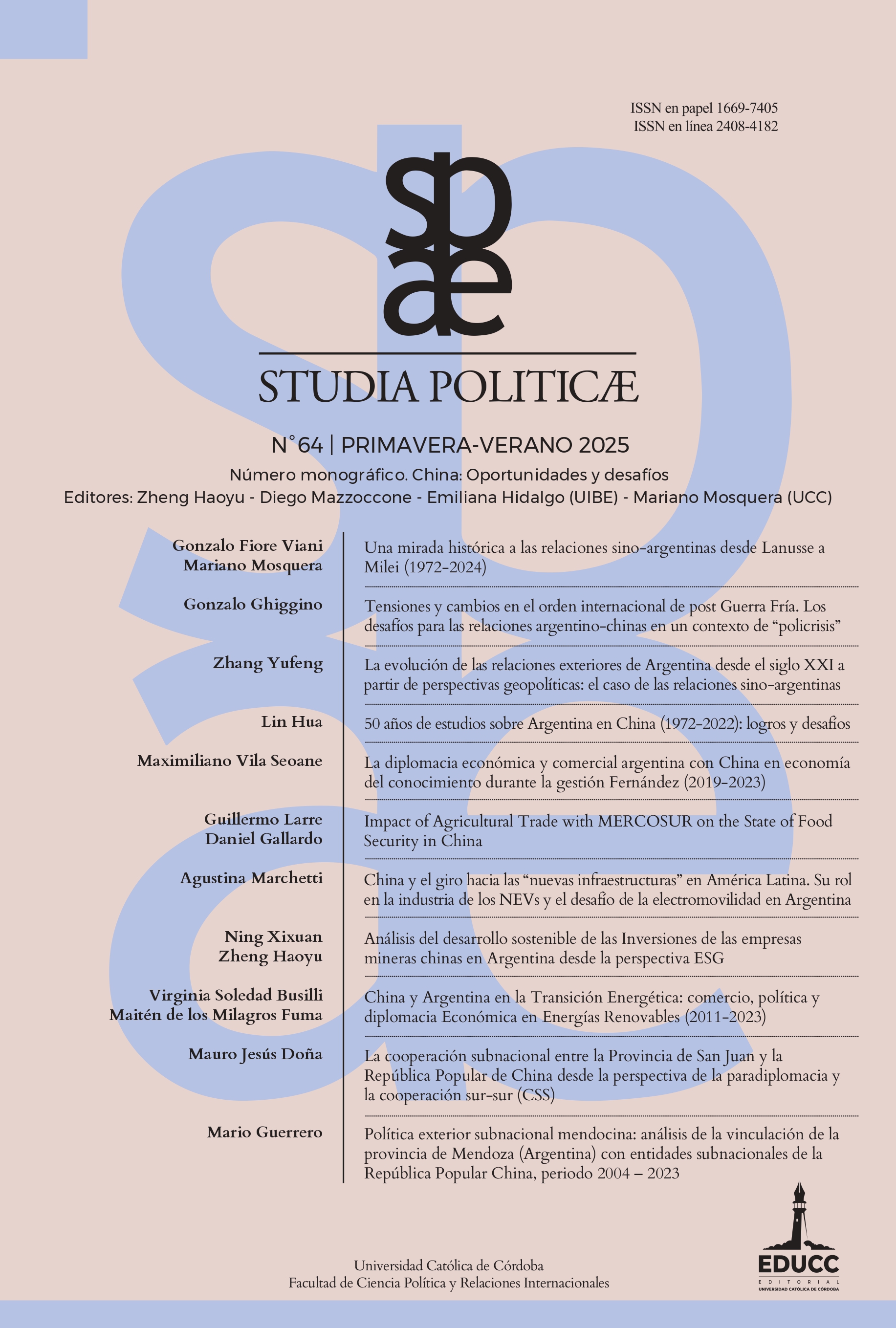
The Evolution of Argentina's Foreign Relations since the 21st Century Based on Geopolitical Perspectives: The Case of Sino-Argentine Relations
DOI:
https://doi.org/10.22529/Keywords:
Foreign Affairs, Argentina, Geopolitics, ChinaAbstract
As one of the major countries in South America, Argentina's foreign relations are deeply involved in international politics. This paper analyzes the geopolitical logic of Argentina's foreign strategy from a geopolitical perspective, and takes China-Argentina relations as an example to analyze the stage-by-stage evolution of Argentina's foreign relations since the 21st century. Through the analysis of Argentina's foreign policies in different ruling periods, it reveals the key role of geopolitical factors. At the same time, the internal and external factors affecting Argentina's foreign policy adjustments are explored, and the geopolitical significance of China-Argentina cooperation is revealed, with the aim of providing theoretical support and practical references for the deepening of China-Argentina relations and the understanding of geopolitical patterns in the Latin American region.Downloads
References
Britannica (Ed.) (2025). Argentina | History, Map, Flag, Population, Language, Currency, & Facts. https://www.britannica.com/place/Argentina
Corigliano, F. (2011). La política exterior del gobierno de Cristina Fernández de Kirchner: una típica política peronista del siglo XXI. Mural Internacional, 2(1), 22-27.
Dahal, D. R. (2024). The Shifting Geopolitics. Journal of Political Science, 185-201.
de Paula, G. (2009). Uso del Instrumento Militar en la Política Antártica - Elementos para el Análisis y su Aplicación en el Caso de Argentina. UNISCI Discussion Papers, (20), 24-35
Gürcan, E. C. (2019). Geopolitical Economy of Post-hegemonic Regionalism in Latin America and Eurasia. Research in Political Economy.
Glassner, M. I. (1986). Geopolitics and conflict in South America: Quarrels among neighbors. Political Geography Quarterly, 5(4), 396-397.doi:10.1016/0260-9827(86)90028-5
Kelly, P. & Child, J. (1989). Geopolitics of the Southern Cone and Antarctica. Lynne Rienner Publishers. https://doi.org/10.1515/9781685855710
Kacowicz, A. M. (2000). Geopolitics and territorial issues: Relevance for South America. Geopolitics, 5(1), 81-100.
Mahan, A. T. (1890). The influence of sea power upon history, 1660-1783.
Malamud, C., y Núñez Castellano, R. (2022). América Latina y la invasión de Ucrania: su incidencia en la economía, la geopolítica y la política interna. Análisis del Real Instituto Elcano (ARI), (26)
Peixoto, J. y Loza, J. (2006). La relación Argentina-Brasil: entre la administración de conflictos y las políticas de cooperación. Estudios: Centro de Estudios Avanzados, (18), 115-129.
Pino Uribe, J. F., López-Aguilar, A. y Abadía, A. A. (2024). Nuevas derechas e izquierdas: una mirada a los desafíos democráticos y los valores en disputa en el siglo XXI. Desafíos, 36(2).
Russell, R., y Tokatlian, J. G. (2013). Implications of the global and regional changes for Argentina’s foreign relations. Journal of Iberian and Latin American Research, 19(2), 251-267. https://doi.org/10.1080/13260219.2013.853356
Steven, D., O’Brien, E. & Jones, B.D. (2014). The New Politics of Strategic Resources: Energy and Food Security Challenges in the 21st Century.
Simonoff, A. (2011). Argentina: cuatro claves de la política exterior reciente (2001-2010). Cuadernos sobre Relaciones Internacionales, Regionalismo y Desarrollo, 6(11), 71-102.
Shqueitzer, M. F. (2022). La política exterior del gobierno de Cristina Fernández de Kirchner hacia la Cuestión Malvinas (2007-2015) [Tesis doctoral]. Universidad Nacional de La Plata.
中国食品土畜进出口商会(CCCFNA). (2024). 【国别贸易】2024年1-5月阿根廷农产品贸易概况. Retrieved from https://www.cccfna.org.cn/maoyitongji/guobiemaoyi/
阮建平.(2016).南极政治的进程、挑战与中国的参与战略——从地缘政治博弈到全球治理.太平洋学报(12),21-30.doi:10.14015/j.cnki.1004-8049.2016.12.003.
邢凯,朱清,邹谢华,龙涛,刘君安,温鹏飞... & 穆一帏.(2023).新能源背景下锂资源产业链发展研究.中国地质(02),395-409.
约翰·蔡尔德,马振岗.(1980).拉丁美洲的地缘政治思想.国外社会科学(04),36-40.
梅春才 & 郭培清.(2017).南极:中国与阿根廷外交的新支点.世界知识(08),60-62.
林华.(2016).阿根廷新政府改革措施及对中阿关系的影响.当代世界(11),54-57.doi:10.19422/j.cnki.ddsj.2016.11.014.
林华.(2022).中国——阿根廷: 从全面战略伙伴关系到命运共同体.美洲观察. Retrieved from http://www.china.com.cn/opinion2020/2022-02/21/content_78062022.shtml?f=pad&a=true
李紫莹.(2012).阿根廷外交政策演变与南美洲区域一体化发展.国际经济合作(02),77-80.
朱翠萍 & 吕嘉欣.(2021).南极治理:地缘政治博弈与国际制度合作.太平洋学报(12),78-92.
方艳华 & 刘志鹏.(2010).阿根廷传统外交思想起源探析.常熟理工学院学报(09),94-97.doi:10.16101/j.cnki.cn32-1749/z.2010.09.015.
张晶,唐庆辉,刘建忠,公茂玉,叶凯臻.(2019). 大国在南美洲的地缘影响分析.世界地理研究,28 (3),11 - 22. DOI:10.3969/j.issn.1004-9479.2019.03.2018075
孙洪波.(2007).基什内尔执政时期阿根廷与美国关系.拉丁美洲研究(03),39-43+80.
夏立安.(1992).当代拉丁美洲地缘政治思想的演变.拉丁美洲研究(05),42-47+59.
吕嘉欣.(2021).阿根廷南极政策:国际制度合作中的主权声索.边界与海洋研究(05),109-126.
刘明.(2015).阿根廷的南极政策探究.拉丁美洲研究(01),41-47.
刘明 & 张洁.(2020).中国与拉美国家的南极合作:动因、实践及对策.太平洋学报(11),73-87.doi: 10.14015/j.cnki.1004-8049.2020.11.007.
乔正高.(2000).英阿马岛战争的地缘政治观.史学集刊(02),64-68.
中国驻阿根廷大使馆经济商务处. (2024). 对外投资合作国别 (地区) 指南:阿根廷 (2024 年版). Retrieved from https://www.mofcom.gov.cn/dl/gbdqzn/upload/agenting.pdf
宋晓丽 & 蓝天.(2024).体系压力、国内政治与阿根廷左翼务实主义南极政策.大连海事大学学报(社会科学版)(03),119-131.
李振福. (2023). “通权论”:传统地缘政治理论的传承和拓展. 理论界, (01), 1-7. doi: 10.13221/j.cnki.lljj.2023.01.014.
刘希妍,窦新月 & 谢峥嵘.(2024).阿根廷农业生产、贸易状况及中阿农业合作分析.农业展望,20(04),93-98.
陈喜峰,陈玉明 & 赵宏军.(2020).南美“锂三角”锂资源产业发展现状与对策建议.国土资源科技管理,37(05),13-21.
孙庭阳. (2023). 阿根廷总统费尔南德斯:阿中共建 “一带一路” 合作是实实在在的行动。中国经济周刊,(20), 15.
姜玉妍 & 徐沛原.(2024). “去美元化” 下中国与拉美货币金融深化合作的机遇与挑战. 东北亚经济研究,8(02),91-106.doi: 10.19643/j.cnki.naer.2024.02.008.
谢慧敏,李春顶 & 邢泽蕾.(2024).美国对拉美经济战略的调整及其影响.拉丁美洲研究,46(03),25-50+142-143.
Additional Files
Published
Issue
Section
License
Copyright (c) 2025 Zhang Yufeng

This work is licensed under a Creative Commons Attribution-NonCommercial-NoDerivatives 4.0 International License.
How to Cite