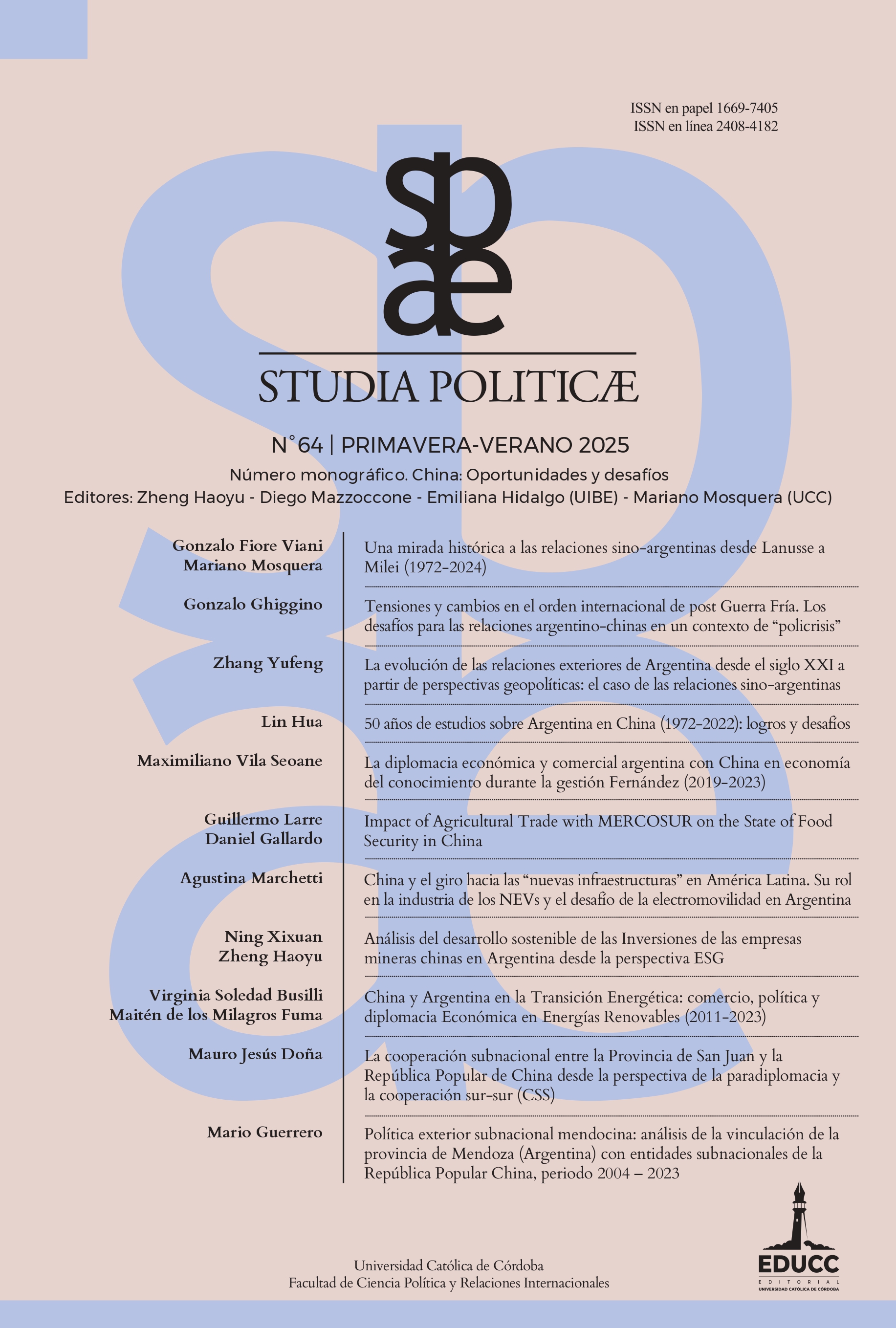
Tensions and changes in the post-Cold War era international order: Challenges for Argentine-Chinese relations in a context of “polycrisis”
DOI:
https://doi.org/10.22529/Keywords:
order, globalization, polycrisis, China, Argentina, IndustryAbstract
Changes in the international order portend a world of tension, where both major powers and emerging countries are decisively affected. The rise of China, the various crises (climate, pandemic, and war), and the United States' lack of response capacity alter not only international relations but the entire global economic system. The responses to this polycrisis by the disputing powers reveal the profound nature of the conflict, which is the challenge of strengthening productive capacity and the role of industry and technology to confront the global competition and the reconfiguration of production. In a globalized world (productively and financially), public policies and the role of state capacities are fundamental to success or failure in the face of the loss of competitiveness and markets. In this context, more than 80 percent of world trade is in manufacturing, and China accounts for 30 percent of industrial production. For Argentina, the challenge is to deal with the rising power that is China in a context of tension and change, while simultaneously implementing policies that allow it to develop and strengthen its productive and industrial infrastructure to more fully integrate into the global economy.Downloads
References
Albaladejo, M. (28 de septiembre de 2017). Industrialización Sostenible en América Latina [Ponencia]. 5th German-Latin American Energy Conference, Buenos Aires, Argentina.
Acharya, M. (2014). The end of American World Order. Polity Press.
Acharya, Amitav. (2017). After Liberal Hegemony: The Advent of a Multiplex World Order. Ethics & International Affairs, 31(3), 271-285.
Barbé, E. (1995). Relaciones Internacionales. Tecnos.
Bekerman, M.; Dulcich, F. y Gaite, P. (2022). Las relaciones económicas de la Argentina con China y su impacto sobre una estrategia productiva de largo plazo. Revista de la CEPAL, (138), 28-47.
Bielschowsky, R. (2009). Sesenta años de la CEPAL: estructuralismo y neoestructuralismo. Revista de la CEPAL (97), 173-194.
De Vuele, F. y Van de Bulke, D. (2010). The global crisis, Foreign Direct Investment and China: Developments and implications. Brussels Institute of Contemporary China Studies.
Economy, E. (2024). China’s Alternative Order. And What America Should Learn from It. Foreign Affairs, Volume 103, Number 3, May-June.
Ferguson, N. y Schularick, M. (2009). The End of Chimerica (Working Paper). Harvard Business School. https://www.hbs.edu/ris/Publication%20Files/10-037_0fdf7d5e-ce9e-45d8-9429-84f8047db65b.pdf
Di Filippo, A. (2017) El estructuralismo latinoamericano: validez y vigencia en el Siglo XXI. Entrelíneas de la Política Económica, (48) 3-18.
Ghiggino, G. (2022). Estado y globalización en China: un análisis de las políticas públicas durante los años de Reforma y Apertura 1978-1998. 1991 Revista de Estudios Internacionales, Julio-Diciembre, 3(2).
Gobierno de Estados Unidos de América (2018). National Defense Strategy of the United States of America. https://media.defense.gov/2020/May/18/2002302061/-1/-1/1/2018-NATIONAL-DEFENSE-STRATEGY-SUMMARY.PDF
Gobierno de Río Negro (2022, 20 de febrero). Acuerdo de cooperación para que INVAP construya un reactor en China [Comunicado de prensa]. https://salud.rionegro.gov.ar/articulo/40579/acuerdo-de-cooperacion-para-que-invap-construya-un-reactor-en-china
He, Y. Qiushi Journal, (3 de marzo de 2023). China's path to modernization unique. http://en.qstheory.cn/2023-03/03/c_865415.htm
Ikenberry, J. (2015). Introduction. En Ikenberry, J. Wang J. y Zhu F. (Eds.). America, China, and the Struggle for World Order: Ideas, Traditions, Historical Legacies, and Global Visions (pp. 1-18). Palgrave Macmillan.
Lewkowicz, J. (18 de julio de 2024). ¿Como está cambiando la inversión china en América Latina?. Dialogue Earth. https://dialogue.earth/es/negocios/como-esta-cambiando-la-inversion-china-en-america-latina/
Kai, H., Huiyung, F., Cha, S. & Weixing, H. (2021). Rethinking Revisionism in World Politics. The Chinese Journal of International Politics, 14(2), 159-186.
Kissinger, H. (2014). World Order, Penguin Press.
Myers, M., Melguzio, A. y Yifang, W. (2024). Nueva infraestructura. Tendencias emergentes de la inversión directa China en América Latina y el Caribe Reporte China LAC 2024, EL Dialogo Liderazgo para las Américas https://www.thedialogue.org/wp-content/uploads/2024/02/Tendencias-emergentes-de-la-inversion-extranjera-directa-de-China-en-America-Latina-y-el-Caribe.pdf
Oviedo, E. (2023). Relaciones internacionales en tiempos de auge chino y declive argentino. Areté Grupo Editor.
Organización Mundial del Comercio (OMC) (2023). Examen estadístico del comercio mundial de 2022. https://www.wto.org/spanish/res_s/publications_s/wtsr_2023_s.htm
Pearson, F. y Rochester, M. (2000). Relaciones Internacionales. Situación Global en el Siglo XXI. Mc Graw Hill.
The State Council of The People´s Republic of China (2024). “China unveils fresh stimulus to boost high-qua economic development [Comunicado de prensa] .https://english.www.gov.cn/news/202409/25/content_WS66f3602ec6d0868f4e8eb3c0.html
United Nations Industrial Development Organization (UNIDO) (2024). Industrial Development Report 2024. https://www.unido.org/idr/idr2024#/
World Economic Forum (2025). The Global Risks Report. https://www.weforum.org/publications/global-risks-report-2025/
Additional Files
Published
Issue
Section
License
Copyright (c) 2025 Gonzalo Ghiggino

This work is licensed under a Creative Commons Attribution-NonCommercial-NoDerivatives 4.0 International License.
How to Cite