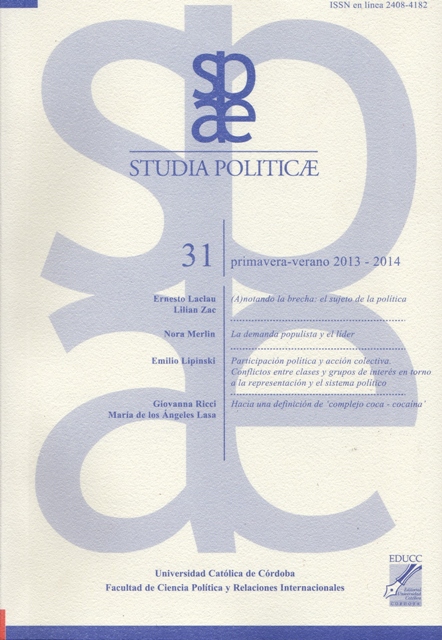
Hacia una definición de complejo coca-cocaína.
Palabras clave:
Drogas Coca Cocaína Complejo Coca-Cocaína América del Sur.Resumen
El presente artículo se propone contribuir con una definición de complejo coca-cocaína identificando sus notas características, a saber: su carácter ilegal; la materia prima y sus productos finales (coca, clorhidrato de cocaína y derivados); sus dimensiones fundamentales (producción, tráfico y consumo); y los actores involucrados que intervienen, reactiva o proactivamente, en la etapas de producción, tráfico y consumo de clorhidrato de cocaína, subproductos y derivados que contienen alcaloide de cocaína. Con esta definición, hasta ahora ausente en la literatura especializada, este texto pretende subsanar una grave deficiencia teórica en los estudios sobre drogas.Descargas
Referencias
ANDREAS, P. y YOUNGERS, C. (1989). Busting the Andean Cocaine Industry: Americas
Counterproductive War on Drugs. World Policy Journal, Vol. 6, N° 3, pp. 529-562.
BURCHARD, R. (1975). Coca Chewing: A new Perspective. En RUBIN, B. (Ed.) Cannabis and Culture, The Hague: Mouton, pp. 463-484.
. (1992). Coca Chewing and Diet. Current Anthropology, Vol. 33, N° 1,
pp. 1-24.
CAMACHO GUIZADO, A. (1981). Droga, corrupción y poder. Marihuana y cocaína en la
sociedad colombiana, Cali: Centro de Investigación y Documentación Social.
CHILDRESS, M.; DOMBEY-MOORE, B; y RESETAR, S. (1994). A System Description of the
Cocaine Trade, Santa Monica (CA): RAND.
CHOUVY, P. (2002). Les territoires de lopium: conflits et trafics du Triangle dOr et du
Croissant dOr, Genève: Olizane.
DESIMONE, J. (2001). The Effect of Cocaine Prices on Crime. Economic Inquiry, Vol.
, N° 4, p. 627-643.
DONELLY, J. (1992). The United Nations and the Global Drug Control Regime. En
SMITH, P. H. (Ed.) Drug Policy in the Americas, Boulder (CO): Westview Press, pp.
-304.
DREYFUS, P. (2002). Border Spillover: Drug Trafficking and National Security in South
America (Tesis Doctoral). Genève: Université de Genève. Inédita.
EUROPOL (2010). Cocaine: A European Union perspective in the global context. Disponible en http://www.emcdda.europa.eu/html.cfm/index6790EN.html. Acceso: 21
de septiembre de 2012.
GOLDSTEIN, P. J. (1985). The Drugs/Violence Nexus: A Tripartite Conceptual Framework. Journal of Drug Issues, Vol. 15, N° 4, pp. 493-506.
GRIFFITH, I. (1997). Drugs and Security in the Caribbean: Sovereignty Under Siege,
University Park (PA): Penn State University Press.
GRINSPOON, L.; y BAKALAR, J. (1976). Cocaine. A Drug and its social evolution, New
York: Basic Books Inc. Publishers.
GUTIÉRREZ NORIEGA, C.; y ZAPATA ORTIZ, V. (1948). Estudios sobre la coca y la cocaína
en el Perú, Lima: Ministerio de Educación Pública.
HENKEL, R. (1986). The Bolivian Cocaine Industry. En MORALES, Edmundo (Ed.).
Drugs in Latin America, Williamsburg (VA): Studies in Third World Societies.
INCIARDI, J. (2008 [2002]). The War on Drugs: The Continuing Saga of the Mysteries
and Miseries of Intoxication, Addiction, Crime, and Public Policy, Boston: Pearson.
INL (1999). International Narcotics Control Strategy Report. Disponible en http://
www.state.gov/j/inl/rls/nrcrpt/1999/index.htm. Acceso: 28 de agosto de 2013.
. (2013). International Narcotics Control Strategy Report. Disponible en http://
www.state.gov/documents/organization/204265.pdf. Acceso: 23 de enero de 2014.
KRASNER, S. (1982). Structural causes and regime consequences: regimes as intervening variables. International Organization, Vol. 36, N° 2, pp. 185-205.
KUEVIÆ, V. (1977). Drug Abuse Control and International Treaties. Journal of Drug
Issues, Vol. 7, N° 1, pp. 35-53.
LABROUSSE, A. (2011). Geopolítica de las drogas, Buenos Aires: Marea.
LEE, D. (1981). Cocaine Handbook. An Essential Reference, Berkeley (CA): And/Or
Press.
LEE, R. (1988). Dimensions of the South American Cocaine Industry. Journal of Interamerican Studies and World Affairs, Vol. 30, N° 2/3, pp. 87-103.
LOVÓN ZAVALA, G. (1993). Perú: Complejo coca-cocaína, problemática y alternativas.
En TOVAR PINZÓN, Hermes (Ed.). La coca y las economías de exportación en América Latina, Albolote: Universidad Hispanoamericana Santa María de la Rábida.
MANSILLA, H. (1994). Repercusiones ecológicas y éticas del complejo coca-cocaiìna.
Serie Drogas Investigación para el Debate, N° 7. La Paz: Seamos.
MANSILLA, H.; y BLANES, J. (1994). La percepción social y los hechos reales del complejo
coca-cocaína. Serie Drogas Investigación para el Debate, N° 9. La Paz: Seamos.
MC ALLISTER, W. (2000). Drug Diplomacy in the Twentieth Century, London: Routledge.
MEJÍA, D.; y POSADA, C. (2010). Cocaine production and trafficking: What Do We
Know? En KEEFER, Philip y LOAYZA, Norman (Eds.). Innocent Bystanders. Developing Countries and the War on Drugs, Basingstoke: Palgrave MacMilland & The
World Bank, pp. 253-300.
MURRA, J. (1986). Notes on Pre-Columbian Cultivation of Coca Leaf. En PACINI, Deborah y FRANQUEMONT, Christine (Ed.). Coca and Cocaine. Effects on People and
Policy in Latin America, Peterborough (NH): Transcript Printing Company.
MUSTO, D. (1993). Pautas en el abuso de drogas y la respuesta en los Estados Unidos.
En SMITH, Peter H. (Ed.). El combate a las drogas en América, México: FCE, pp.
-85.
. (2000). Drugs in America. A Documentary History, New York: New York University Press.
NACIONES UNIDAS (1950). Informe de la Comisión de Estudio de las Hojas de Coca
(E/1666 - E/CN.7/AC.2/1), Consejo Económico y Social. Disponible en http://
www.druglawreform.info/images/stories/documents/coca-inquiry-1950s.pdf. Acceso:
de marzo de 2013.
. (1961). Convención Única sobre Estupefacientes. Disponible en https://
www.unodc.org/pdf/convention_1961_es.pdf. Acceso: 27 de septiembre de 2013.
. (1988). Convención contra el Tráfico Ilícito de Estupefacientes y Sustancias
Psicotrópicas. Disponible en https://www.unodc.org/pdf/convention_1988_es.pdf.
Acceso: 27 de septiembre de 2013.
OMS (1994). Lexicon of Alcohol and Drug Terms, London: London: Macmillan/Clays.
OSORIO MACHADO, L. (2001). The Eastern Amazon Basin and the CocaCocaine Complex. International Social Science Journal, Vol. 53, N° 169, pp. 387-95.
PLOWMAN, T. (1986). Coca Chewing and the Botanical Origins of Coca (Erythroxylum
SPP.) in South America. En Pacini, Deborah y Franquemont, Christine (Ed.). Coca
and Cocaine. Effects on People and Policy in Latin America, Peterborough (NH):
Transcript Printing Company.
QUIROGA, J. (1990). Coca/cocaína: una visión boliviana, La Paz: AIPE-PROCOM /
CEDLA / CID.
RENGERT, G. (1996). The Geography of Illegal Drugs, Boulder (CO): Westview Press.
SINHA, J. (2001). The History and Development of the Leading International Drug Control Conventions. Ottawa: Library of Parliament. Disponible en http://
www.parl.gc.ca/Content/SEN/Committee/371/ille/library/history-e.pdf. Acceso: 12
de diciembre de 2012.
STREATFEILD, D. (2001). Cocaine. An Unauthorised Biography, London: Virgin.
THOUMI, F. (1995). Los efectos económicos de la industria de drogas ilegales y las
agendas de política en Bolivia, Colombia y Perú. Colombia Internacional, N° 29,
pp. 7-17.
. (2003). Illegal Drugs, Economy, and Society in the Andes. Washington DC:
Woodrow Wilson Center Press.
. (2012). Illegal Drugs, Anti-Drug Policy Failure, and the Need for Institutional
Reforms in Colombia. Substance Use & Misuse, N° 7, pp. 972-1004.
ROGERS, E.; y SHOEMAKER, F. (1971). Communication of innovations: A cross-cultural
approach, New York: Free Press.
ROSSI, A. (1996). Narcotráfico y Amazonía ecuatoriana, Quito: Abya-Yala.
SAFFER, H.; y DHAVAL, D. (2005). Mental Illness and the Demand for Alcohol, Cocaine,
and Cigarettes. Economic Inquiry, Vol. 43, N° 2, pp. 229-246.
TOVAR PINZÓN, H. (1994). La Economiìa de la Coca en Ameìrica Latina. El paradigma
colombiano. Nueva Sociedad, N° 130, pp. 86-111.
TULLIS, LaMond (1991). Handbook of Research on the Illicit Drug Traffic. Socioeconomic and Political Consequences, Westport (CT): Greenwood Press.
UNODC (2003). Terminology and Information on Drugs, Laboratory and Scientific
Section. Disponible en http://www.unodc.org/pdf/publications/report_2003-09-
_1.pdf. Acceso: 22 de marzo de 2013.
. (2008). World Drug Report, Division for Policy Analysis and Public Affairs.
Disponible en http://www.unodc.org/documents/wdr/WDR_2008/WDR_2008_
eng_web.pdf Acceso: 10 de enero de 2013.
Publicado
Número
Sección
Licencia
Derechos de autor 2015 Studia Politicæ

Esta obra está bajo una licencia internacional Creative Commons Atribución-NoComercial-SinDerivadas 4.0.


