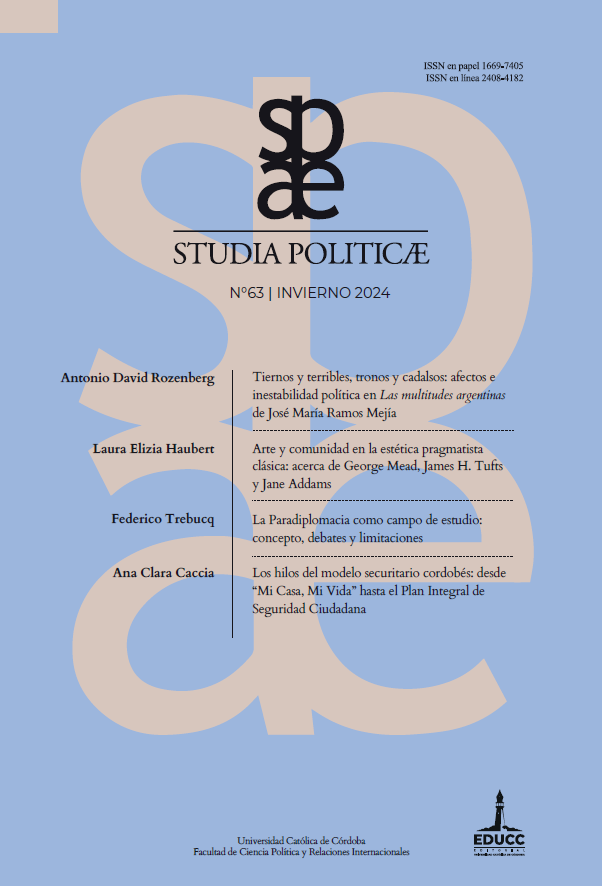
Arte y comunidad en la estética pragmatista clásica: acerca de George Mead, James H. Tufts y Jane Addams
DOI:
https://doi.org/10.22529/Palabras clave:
pragmatismo, estética pragmatista, George Mead, Jane Addams, democracia, Jame TuftsResumen
La estética pragmatista clásica, plasmada en la obra de John Dewey —particularmente en su libro El arte como experiencia, publicado originalmente en 1934—, ha sido objeto de frecuentes análisis debido a su enfoque en temas como la experiencia estética, el arte, la comunidad y la democracia. No obstante, estos conceptos no son exclusivos de la producción estética de Dewey y se pueden identificar también en las obras de otros pensadores pragmatistas clásicos. El objetivo de esta investigación es ampliar la perspectiva histórica, destacando cómo estos temas se manifiestan en las obras de tres filósofos pragmatistas menos conocidos: George H. Mead (1863-1931), James H. Tufts (1862-1942) y Jane Addams (1860-1935). Estos pensadores anticiparon las ideas de Dewey al subrayar el poder del arte y la experiencia estética como herramientas capaces de generar una experiencia de comunidad que contribuye a la preservación de la vida democrática.Descargas
Referencias
Addams, J. (1895). The Art-Work Done by Hull-House. The Forum, 19, 614-617.
Addams, J. (1902). Democracy and Social Ethics. Macmillan Publishers.
Addams, J. (1916). Twenty Years at Hull-House. Norwood Press.
Addams, J. (1985). Jane Addams on Education. Teacher College Press.
Barrena, S. (2015). La belleza en Charles S. Peirce: origen y alcance de sus ideas estéticas. EUNSA.
Boronat, N. S. M. y Bella, M. (2022). Women in Pragmatism: Past, Present and Future. Springer.
Campbell, J. (1983). Mead and Pragmatism. Symbolic Interaction, 6(1), 155-164.
Campbell, J. (Ed.). (1992). Selected Writings of James Hayden Tufts. Southern Illinois University Press.
Campbell, J. (2016). Tufts, James Hayden. En J. R. Shook (Ed.), The Bloomsbury Encyclopedia of Philosophers in America: From 1600 to the Present (pp. 978-980). Bloomsbury.
Cecchi, D. (2019). Devices in Experimentation: The Work of Art in a Pragmatist Perspective, Between Somaesthetics and Techno-Aesthetics. Aisthesis, 12(9), 87-99. https://doi.org/10.13128/Aisthesis-10724
Côté, J.-F. (2015). George Herbert Mead’s Concept of Society. A Critical Reconstruction. Paradigm Publishers.
Crick, N. (2019). Dewey for a New Age of Fascism: Teaching Democratic Habits. The Pennsylvania State University Press.
Dewey, J. (2008). El arte como experiencia (Trad. J. Claramonte). Paidós. (Trabajo original publicado en 1934).
Dewey, J. y Tufts, J. H. (1908). Ethics. University of California Libraries.
Feinstein, H. M. (1984). Becoming William James. Cornell University Press.
Hamington, M. (2009). The Social Philosophy of Jane Addams. University of Illinois Press.
Huebner, D. R. (2014). Becoming Mead: The Social Process of Academic Knowledge. The University of Chicago Press.
Joas, H. (1987). Symbolic Interactionism. En A. Giddens y J. H. Turners (Eds.), Social Theory Today (pp. 82-116). The MIT Press.
Lowe, B. J. (2022). The Complementary Theory and Practice of Jane Addams and George Herbert Mead: Bending Toward Justice. En P. M. Shields, M. Hamington, y J. Soeters (Eds.), The Oxford Handbook of Jane Addams (pp. 129-148). Oxford University Press.
Martin, J. (2002). The Education of John Dewey. Columbia University Press.
Mattern, M. (1999). John Dewey, Art and Public Life. The Journal of Politics, 61(1), 54-75. https://doi.org/10.2307/2647775
Mead, G. (1926). The Nature of Aesthetic Experience. International Journal of Ethics, 36(4), 382-393. https://doi.org/10.1086/intejethi.36.4.2377635
Moskop, W. W. (2020). Jane Addams on Inequality and Political Friendship. Routledge.
Musgrave, L. R. (2010). Addam’s Philosophy of Art: Feminist Aesthetics and Moral Imagination at Hull House. En M. Hamington (Ed.), Feminist Interpretations of Jane Addams (pp. 107-123). Pennsylvania State University Press.
Nussbaum, M. C. (2010). Sin fines de lucro. Por qué la democracia necesita de las humanidades. Katz Editores.
Oliveras, E. (2015). Estética: la cuestión del arte. Emecé.
Raeber, M. I. (2013). The Art of Democracy—Art as a Tool for Developing Democratic Citizenship and Stimulating Public Debate: A Rortyan-Deweyan Account. Humanities, 2(2), 176-192. https://doi.org/10.3390/h2020176
Ramazzotto, N. (2024). Pragmatist Aesthetics. International Lexicon of Aesthetics. 1-7. https://lexicon.mimesisjournals.com/0Pragmatist%20Aesthetics.pdf
Riedler, M. (2024). The Artful Life as Transactional Process: How John Dewey Connects Art, Democracy, and Everyday Experience. International Journal of Progressive Education, 20(2), 57-64. https://ijpe.inased.org/makale/4474
Seigfried, C. H. (1991). Where Are All the Pragmatist Feminists? Hypatia: A Journal of Feminist Philosophy, 6(2), 1-20. https://doi.org/10.1111/j.1527-2001.1991.tb01390.x
Seigfried, C. H. (1996). Pragmatism and Feminism: Reweaving the Social Fabric. The University of Chicago Press.
Shiner, L. (2017). La Invención del arte: una historia cultural. Paidós.
Shusterman, R. (1992). Pragmatist Aesthetics: Living Beauty, Rethinking Art. Blackwell.
Skowroński, K. P. (2011). Democratic Values in the Aesthetic of Classic American Pragmatism. Human Affairs, 21(4), 335-346. https://doi.org/10.2478/s13374-011-0035-3
Tufts, J. H. (1903). On the Genesis of the Aesthetic Categories. The Philosophical Review, 12(1), 1-15. https://doi.org/10.2307/2176814
Vaamonde Gamo, M. V. (2023). Aesthetic Pragmatism and Feminism of Jane Addams. European Journal of Pragmatism and American Philosophy, XV(1), 1-16. https://doi.org/10.4000/ejpap.3244
Whipps, J. y Lake, D. (2020). Pragmatism Feminism. En E. N. Zalta y U. Nodelman (Eds.), The Stanford Encyclopedia of Philosophy. https://plato.stanford.edu/archives/win2020/entries/femapproach-pragmatism/
Publicado
Número
Sección
Licencia
Derechos de autor 2025 Laura Elizia Haubert

Esta obra está bajo una licencia internacional Creative Commons Atribución-NoComercial-SinDerivadas 4.0.
Cómo citar