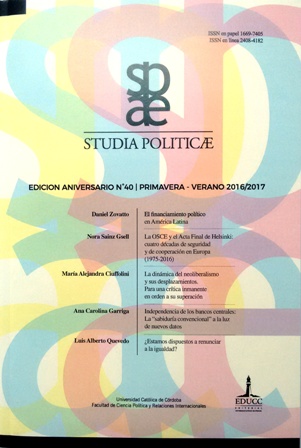
Independencia de los bancos centrales: La "sabiduría convencional" a la luz de nuevos datos.
DOI:
https://doi.org/10.22529/sp.v0i40.1261Palabras clave:
Independencia de bancos centrales Política monetaria Delegación Bases de datos Efectos de selecciónResumen
Este artículo utiliza la base de datos más exhaustiva sobre independencia
de bancos centrales para ilustrar inconsistencias entre la sabiduría convencional
y la evidencia empírica en relación con estas instituciones
monetarias. Datos descriptivos muestran que la dinámica reformista de
los bancos centrales no es un proceso exclusivo de la década de los noventa
y que, aunque la mayoría de las reformas incrementan la delegación
de política monetaria a los bancos centrales, ha habido también importantes
revocaciones de la independencia de los bancos centrales.
Asimismo, los países en vías de desarrollo en general y los regímenes
autoritarios en particular, exhiben interesantes dinámicas en el diseño
institucional de sus bancos centrales. Estas dinámicas habían sido ignoradas
hasta el presente y abren nuevas vías de investigación para el futuro.
Descargas
Referencias
ACEMOGLU, D.; JOHNSON, S.; QUERUBIN, P. y ROBINSON, J. A.(2008). When Does Policy
Reform Work? The Case of Central Bank Independence in NBER Working Paper nº
Cambridge, MA: National Bureau of Economic Research.
ALESINA, A.; MIRRLEES, J. y NEUMANN, M. J. M. (1989). Politics and Business Cycles in
Industrial Democracies. Economic Policy 4: 55-98.
ALESINA, A.; ROUBINI, N. y COHEN, G. D. (1997). Political Cycles and the Macro-economy: MIT press.
ALESINA, A., y SUMMERS, L. H. (1993). Central Bank Independence and Macro-economic Performance: Some Comparative Evidence. Journal of Money, Credit, and
Banking 25: 151-63.
ALPANDA, S. y HONIG, A. (2009). The Impact of Central Bank Independence on Political Monetary Cycles in Advanced and Developing Nations. Journal of Money, Credit and Banking 41: 1365-89.
BARRO, R. J. y GORDON, D. (1983). Rules, Discretion and Reputation in a Model of
Monetary Policy. Journal of Political Economy 91: 101-21.
BEARCE, D. H. (2008). Not Complements, But Substitutes: Fixed Exchange Rate Commitments, Central Bank Independence, and External Currency Stability. International Studies Quarterly 52: 807-24.
BENDOR, J.; GLAZER, A. y HAMMOND, T. H. (2001). Theories of Delegation. Annual Review of Political Science 4: 235-69.
BERNHARD, W. (1998). A Political Explanation of Variations in Central Bank Independence. American Political Science Review 92: 311-27.
BERNHARD, W. y LEBLANG, D. (2002). Political Parties and Monetary Commitments.
International Organization 56: 803-30.
BLINDER, A. S. (1998). Central Banking in Theory and Practice. Cambridge, MA: MIT
Press.
BODEA, C. (2010). Exchange Rate Regimes and Independent Central Banks: A Correlated Choice of Imperfectly Credible Institutions. International Organization 64:
-42.
BODEA, C.; GARRIGA, A. C. y HIGASHIJIMA, M. (2016). Monetary Constraints, Spending, and the Autocratic Survival in Dominant Party Regimes. Paper presented at
the 2016 annual meeting of the American Political Science Association, Philadelphia, PA.
BODEA, C. y HICKS, R. (2015a). International Finance and Central Bank Independence:
Institutional Diffusion and the Flow and Cost of Capital. Journal of Politics 77:
-84.
. (2015b). Price Stability and Central Bank Independence: Discipline, Credibility, and Democratic Institutions. International Organization 69: 35-61.
BODEA, C. y MASAAKI, H. (2015). Central Bank Independence and Fiscal Policy: Can
the Central Bank Restrain Deficit Spending?. British Journal of Political Science
FirstView: 1-24.
BOYLAN, D. M. (1998). Preemptive Strike: Central Bank Reform in Chiles Transition
from Authoritarian Rule. Comparative Politics 30: 443-62.
BROZ, J. L. (2002). Political System Transparency and Monetary Commitment Regimes. International Organization 56: 861-87.
CARSTENS, A. y JÁCOME, L. I. (2005). La Reforma de los Bancos Centrales Latinoamericanos: Avances y desafíos. El Trimestre Económico 72: 683-732.
CÉSPEDES, L. F. y VALDÉS P., R. (2006). Autonomía de Bancos Centrales: La Experiencia Chilena. Economía Chilena 9: 25-45.
CLARK, W. R. y AREL-BUNDOCK, V. (2013). Independent but Not Indifferent: Partisan
Bias in Monetary Policy at the Fed. Economics & Politics 25: 1-26.
CLARK, W. R.; GOLDER, S. N. y POAST, P. (2013). Monetary Institutions and the Political Survival of Democratic Leaders. International Studies Quarterly 57: 556-67.
CROWE, C. y MEADE, E. E. (2007). The Evolution of Central Bank Governance around
the World. Journal of Economic Perspectives 21: 69-90.
CUKIERMAN, A. (1992). Central Bank Strategy, Credibility and Independence: Theory
and Evidence. Cambridge, MA: The MIT Press.
. (2008). Central Bank Independence and Monetary Policymaking Institutions -
Past, Present and Future. European Journal of Political Economy 24: 722-36.
CUKIERMAN, A.; MILLER, G. P. y NEYAPTI, B. (2002). Central Bank Reform, Liberalization, and Inflation in Transition Economies. An International Perspective. Journal
of Monetary Economics 49: 237-64.
CUKIERMAN, A.; WEBB, S. B. y NEYAPTI, B. (1992). Measuring the Independence of
Central Banks and Its Effect on Policy Outcome. The World Bank Economic Review 6: 353-98.
DE JONG, E. (2002). Why are Price Stability and Statutory Independence of Central
Banks Negatively Correlated? The Role of Culture. European Journal of Political
Economy 18: 675-94.
DEBELLE, G. y STANLEY, F. (1995). How Independent Should a Central Bank Be? in
Goals, Guidelines and Constraints Facing Monetary Policymakers, ed. Jeffrey C.
Fuhrer, Conference Series Nº 38. Boston, MA: Federal Reserve Bank of Boston.
-221.
EIJFFINGER, S. C. W. y DE HAAN, J. (1996). The Political Economy of Central Bank Independence. Paper presented at the Princeton Special Papers in International Economics, Nº 19, Princeton, NJ.
EPSTEIN, G. 2009. Post-war Experiences with Developmental Central Banks: The Good,
the Bad and the Hopeful. New York, NY: United Nations, http://unctad.org/en/
Docs/gdsmdpg2420091_en.pdf.
FERNÁNDEZ-ALBERTOS, J. (2015). The Politics of Central Bank Independence. Annual
Review of Political Science 18: 217-37.
FRANZESE, R. J. (1999). Partially Independent Central Banks, Politically Responsive
Governments, and Inflation. American Journal of Political Science 43: 681-706.
GALBRAITH, J. K. (1998 [1958]) The Affluent Society. Houghton Mifflin.
GARRIGA, A. C. (2016a). Central Bank Independence in the World: A New Data Set.
International Interactions 42: 849-68.
. (2016b). Central Bank Independence in the World: A New Data Set. Harvard
Dataverse.
GRILLI, V.; MASCIANDARO, D. y Tabellini, G. (1991). Political and Monetary Institutions
and Public Financial Policies in the Industrial Countries. Economic Policy: 341-92.
INTERNATIONAL MONETARY FUND (1999). Code of Good Practices on Transparency in
Monetary and Financial Policies: Declaration of Principles. Washington, DC: International Monetary Fund.
JENSEN, H. (1997). Credibility of Optimal Monetary Delegation. The American Economic Review 87: 911-20.
JOHNSON, J. (2006). Two-Track Diffusion and Central Bank Embeddedness: The Politics
of Euro Adoption in Hungary and the Czech Republic. Review of International Political Economy 13: 361-86.
KEEFER, P. y STASAVAGE, D. (2002). Checks and Balances, Private Information, and the
Credibility of Monetary Commitments. International Organization 56: 751-74.
. (2003). The Limits of Delegation: Veto Players, Central Bank Independence,
and the Credibility of Monetary Policy. The American Political Science Review 97:
-23.
KLOMP, J. y DE HAAN, J. (2010). Inflation and Central Bank Independence: A Meta Regression Analysis. Journal of Economic Surveys 24: 593-621.
KYDLAND, F. E. y PRESCOTT, E. C. (1977). Rules Rather Than Discretion: The Inconsistency for Optimal Plans. Journal of Political Economy 85: 473-91.
LOHMANN, S. (1998). Federalism and Central Bank Independence: The Politics of German Monetary Policy. World Politics 50: 401-46.
MARSHALL, M. G. y Jaggers, K. Polity IV Dataset. Center for International Deve-lopment and Conflict Management. University of Maryland.
MAXFIELD, S. (1997). Gatekeepers of Growth: The International Political Economy of
Central Banking in Developing Countries. Princeton, NJ: Princeton University
Press.
MESEGUER, C. (2005). Policy Learning, Policy Diffusion, and the Making of a New
Order. Annals of the American Academy of Political and Social Science 598:
-82.
NEYAPTI, B. y DINÇER, N. (2008). What Determines the Legal Quality of Bank Regulation and Supervision?. Contemporary Economic Policy 26: 607-22.
PASTOR, M. y WISE, C. (1997). State Policy, Distribution and Neoliberal Reform in
Mexico. Journal of Latin American Studies 29: 419-56.
POLILLO, S. y GUILLÉN, M. F. (2005). Globalization Pressures and the State: The Global Spread of Central Bank Independence. American Journal of Sociology 110:
-802.
REENOCK, C.; STATON, J. K. y RADEAN, M. (2013). Legal Institutions and Democratic
Survival. The Journal of Politics 75: 491-505.
RODRIK, D. (1991). Policy Uncertainty and Private Investment in Developing Coun-
tries. Journal of Development Economics 36: 229-42.
ROGOFF, K. S. (1985). The Optimal Degree of Commitment to an Intermediate Monetary Target. Quarterly Journal of Economics 100: 1169-89.
ROSAS, G. (2006). Bagehot or Bailout? An Analysis of Government Responses to Banking Crises. American Journal of Political Science 50: 175-91.
VAN WIJNBERGEN, S. (1985). Trade Reform, Aggregate Investment and Capital Flight.
Economics Letters 19: 369-72.
WORLD BANK (1992). How the Independence of Central Banks Affects Policy Outcomes. In World Bank Policy Research Bulletin. Vol. 3. Washington, DC:
World Bank.
Publicado
Número
Sección
Licencia
Derechos de autor 2017 Studia Politicæ

Esta obra está bajo una licencia internacional Creative Commons Atribución-NoComercial-SinDerivadas 4.0.


