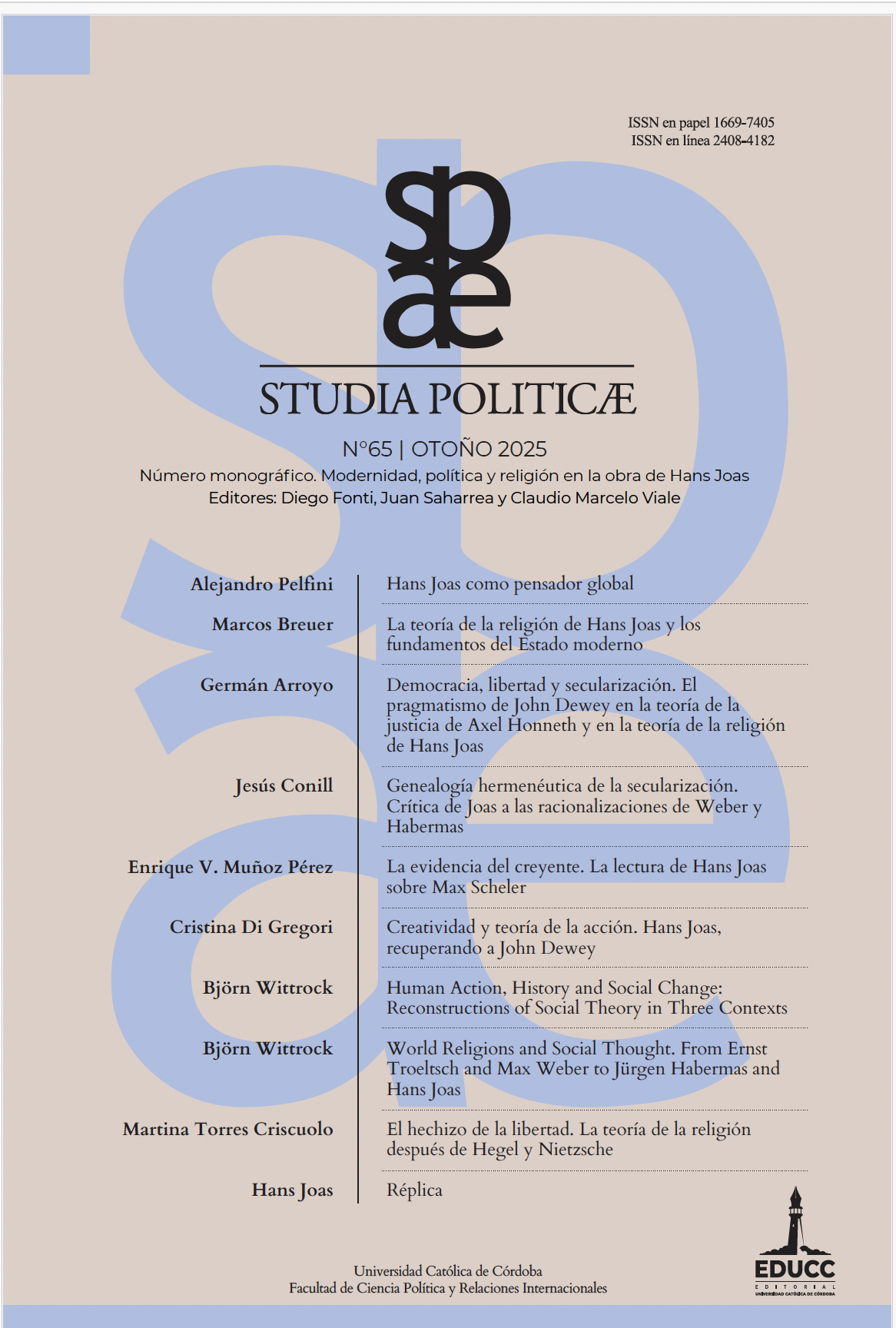
La evidencia del creyente. La lectura de Hans Joas sobre Max Scheler
DOI:
https://doi.org/10.22529/sp.2025.65.05Palabras clave:
evidencia, creyente, religión, sentimientoResumen
En el presente trabajo, no me propongo evaluar si la interpretación realizada por Joas acerca de Scheler es pertinente o justa, sino dar un paso más allá. Mi objetivo es reflexionar sobre un tópico central —que abordan tanto Joas como Scheler—, para cualquier creyente: la evidencia. ¿Qué es la evidencia para un creyente? El planteamiento del presente trabajo, entonces, sostiene que la evidencia en Scheler (2007), especialmente en De lo eterno en el hombre, tiene un carácter religioso que viene a superar la aproximación epistemológica de Husserl (1967) sobre el concepto de “evidencia” en las Investigaciones lógicas. De hecho, este es uno de los tópicos que más valora Joas en su interpretación sobre Max Scheler.
Descargas
Referencias
Anton Mlinar, I. M. (2014). La evidencia en los Prolegómenos y en las Investigaciones lógicas. Primeros aportes para una comprensión modal de la evidencia en Husserl. Investigaciones fenomenológicas, (11), 33-56. http://hdl.handle.net/11336/33900
Haffesbrink, H. (1931). Das Problem des Religiösen Gegenstandes bei Max Scheler. Zeitschrift für Systematische Theologie, (8), 145-180.
Husserl, E. (1967). Investigaciones lógicas (vols. 1-2). Revista de Occidente.
Joas, H. (2020). Im Bannkreis der Freiheit. Religionstheorie nach Hegel und Nietzche. Suhrkamp.
Joas, H. (2024). El hechizo de la libertad. La teoría de la religión después de Hegel y Nietzsche. Sal Terrae.
Muñoz Pérez, E. V. (2023). Fenomenología y religión después de un siglo: un balance provisional. Erasmus. Revista para el Diálogo Intercultural, 25, 1-22. https://qellqasqa.com.ar/ojs/index.php/erasmus/article/view/680
Scheler, M. (2007). De lo eterno en el hombre. Ediciones Encuentro.
Publicado
Número
Sección
Licencia
Derechos de autor 2025 Enrique V. Muñoz Pérez

Esta obra está bajo una licencia internacional Creative Commons Atribución-NoComercial-SinDerivadas 4.0.


