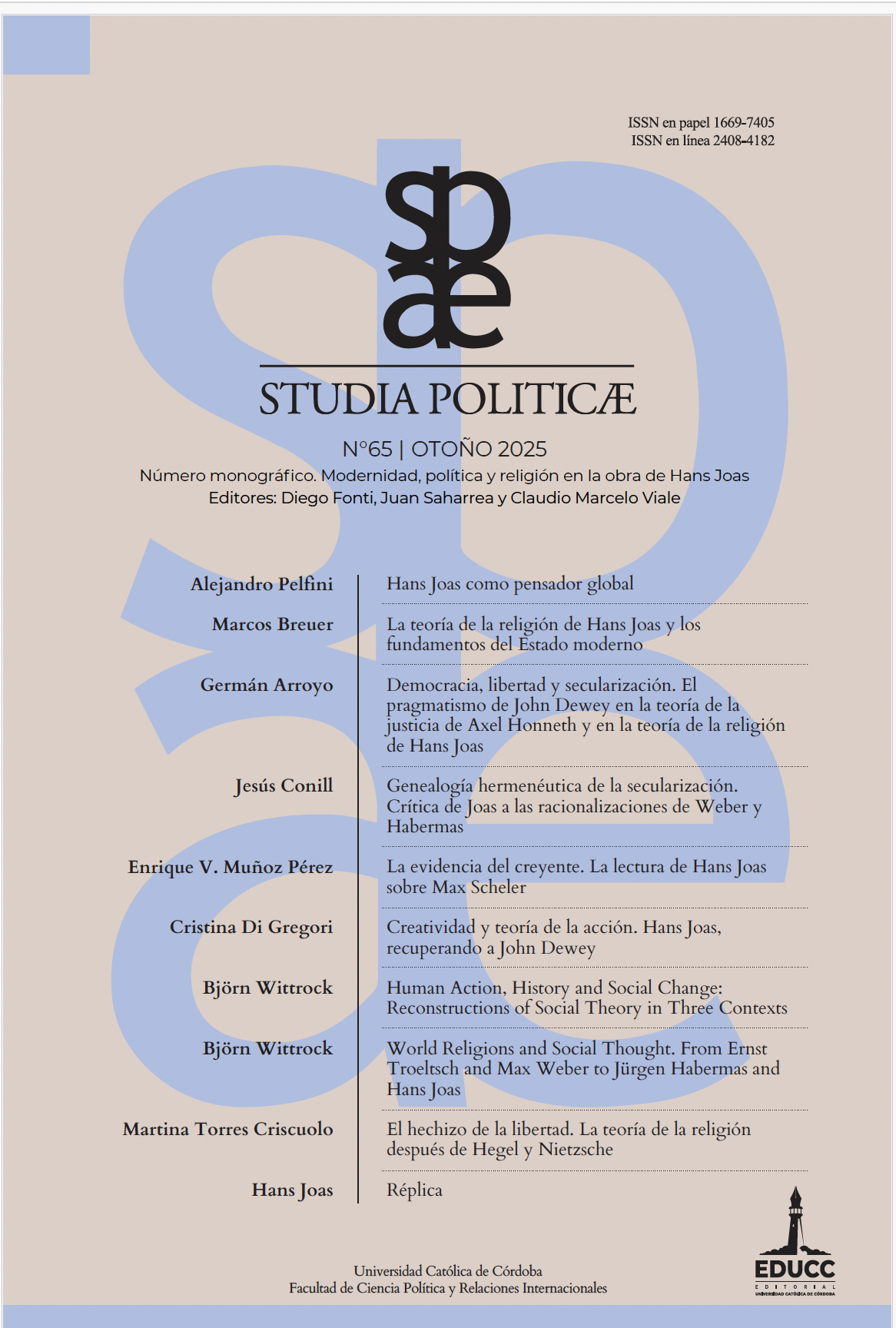
Hans Joas como pensador global
DOI:
https://doi.org/10.22529/Palabras clave:
gobal, religión, pragmatismo, gobernanzaResumen
Dentro de las áreas en las que se ha destacado Hans Joas y ha dedicado sus estudios y su prolífica obra, se suelen mencionar los estudios sobre religión, la formación de los valores, la genealogía de los derechos humanos y la creatividad de la acción social. No obstante, han recibido poca atención las contribuciones de este autor al análisis de lo global, así como su relevancia como pensador que, en su recorrido intelectual también alcanza una dimensión global. Esta apertura no se manifiesta solo en un recorrido intelectual (pensador global) sino que comienza a ser un objeto propio de sus indagaciones (pensador de lo global); por ejemplo, en relación con el rol universal de la religión y de la Iglesia católica, la genealogía de los derechos humanos y la precariedad de la paz en un mundo cada vez más desigual y riesgoso. Sin embargo, son escasas las instancias en las que el autor se detiene en estos asuntos en toda su complejidad. Sus aportes provienen sobre todo de menciones al margen, de preguntas que deja abiertas y de respuestas que ofrece en entrevistas académicas. Por lo tanto, en este artículo nos proponemos reconstruir algunas de estas diversas y dispersas aproximaciones a la escala global y sus atributos, intentando resumir sus aportes originales y situarlos como parte del recorrido que hace el autor dentro de su vasta obra. A su vez, destacaremos la perspectiva de análisis que fue construyendo a lo largo del tiempo y durante su transición de sociólogo (o, más precisamente, de teórico social) a estudioso de lo religioso en general y que, además, hace explícito su catolicismo.
Descargas
Referencias
Arnason, J., Eisenstadt, S., y Wittrock, B. (Eds.). (2005). Axial Civilizations and World History. Brill.
Basaure, M. (2018). Sacralidad, cohesión social y desencantamiento. Conversación con Hans Joas. Revista de Estudios Sociales, 1(66), 93-105. https://doi.org/10.7440/res66.2018.09
Bellah, R., Madsen, R., Sullivan, W., Swidler, A., y Tipton, S. M. (1985). Habits of the Heart. Individualism and Commitment in American Life. University of California Press.
Casanova, J. (1994). Public Religions in the Modern World. University of Chicago Press.
Casanova, J. (2009). Europas Angst vor der Religion. Berlin University Press.
Chakrabarty, D. (2000). Provincializing Europe. Postcolonial Thought and Historical Difference. Princeton University Press.
Carozzi, M. J. (1993). Tendencias en el estudio de nuevos movimientos religiosos en América: los últimos veinte años. Revista Sociedad y Religión, 1(10/11), 3-23.
Costa, S. (2006). Desprovincializando a sociologia: a contribuição pós-colonial. Revista Brasileira de Ciencias Sociais, 21(60), 117-134. https://doi.org/10.1590/S0102-69092006000100007
Dewey, J. (1975). Democracia y educación. Ediciones Morata.
Habermas, J. (1984). Teoría de la acción comunicativa. Taurus.
Jaspers, K. (1949). Vom Ursprung und Ziel der Geschichte. Piper.
Jay, M. (2009). Cantos de Experiencia. Variaciones modernas sobre un tema universal. Paidós.
Joas, H. (1996). Die Kreativität des Handelns. Suhrkamp.
Joas, H. (1997). Die Entstehung der Werte. Suhrkamp.
Joas, H. (2015). La sacralidad de la persona. Una nueva genealogía de los derechos humanos. UNSAM Edita.
Joas, H. (2024). El hechizo de la libertad. La teoría de la religión después de Hegel y Nietzsche. Sal Terrae.
Juergensmeyer, M., Kitts, M., y Jerryson, M. (Eds.). (2016). Violence and the World's Religious Traditions: An Introduction. Oxford University Press.
Kaldor, M. (2005). La sociedad civil global. Una respuesta a la guerra. Tusquets.
Mallimaci, F. (Ed.). (2013). Atlas de las creencias religiosas en la Argentina. Biblos.
Niebuhr R. (1922). The Social Sources Of Denominationalism. Living Age Books.
Parker, C. (1996). Otra lógica en América Latina: religión popular y modernización capitalista. Fondo de Cultura Económica.
Pelfini, A. (2013). Del cosmopolitismo “atlántico” al cosmopolitismo minimalista. La subjetivación de América Latina en una Modernidad Plural. Devenires. Revista de Filosofía y Filosofía de la Cultura, 14(28), 13-38. https://publicaciones.umich.mx/revistas/devenires/ojs/article/view/384
Sanahuja, J. A. y López Burián C. (2023). Las “nuevas derechas” y la ultraderecha neopatriota: conceptos, teoría y debates en el cruce de ideología y globalización. En J. A. Sanahuja y P. Stefanoni (Eds.), Extremas derechas y democracia: perspectivas iberoamericanas (13-36). Fundación Carolina.
Publicado
Número
Sección
Licencia
Derechos de autor 2025 Alejandro Pelfini

Esta obra está bajo una licencia internacional Creative Commons Atribución-NoComercial-SinDerivadas 4.0.


